

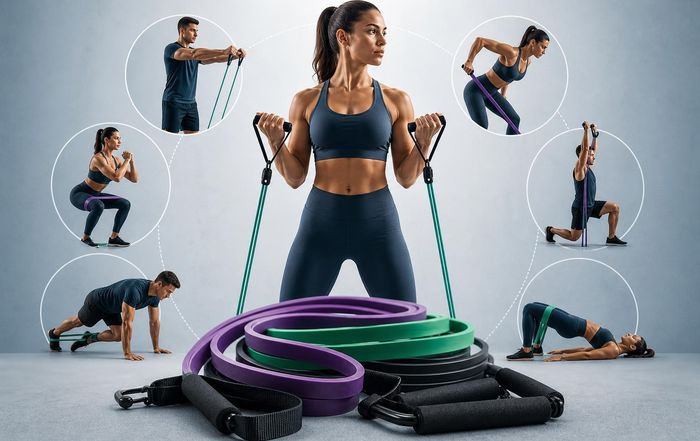
How Resistance Bands Can Power a True Full-Body Strength Workout
Resistance bands have quietly moved from rehab clinics and hotel gyms into serious strength programs, from beginners at home to elite athletes. They are light, inexpensive, and portable-but they can also provide demanding resistance that challenges muscles through a full range of motion. For people who want to build strength without a full rack of weights, understanding how bands actually work and how to program them for full-body training is crucial.
This guide looks at the science behind resistance bands, how they compare to free weights, and how to build a balanced head-to-toe program using little more than a set of bands and some space on the floor.
What Resistance Bands Actually Do to Your Muscles
Resistance bands create tension through elastic stretch. As you pull a band farther, the resistance increases, a property called variable resistance. Unlike a dumbbell that weighs the same at every point in a lift, bands become more challenging as they lengthen, often matching the part of the movement where you are naturally stronger (for example, near the top of a squat or press).
Research from organizations such as the American Council on Exercise (ACE) and peer-reviewed studies accessible via PubMed (NCBI) suggest that, when resistance is matched, training with elastic bands can stimulate similar strength gains to traditional free weights for many exercises. Bands load muscles through both concentric (lifting) and eccentric (lowering) phases, and they can be anchored in multiple directions to challenge stabilizing muscles that sometimes contribute less during machine-based training.
Because bands are relatively low impact and allow natural joint paths, they are widely used in physical therapy and sports rehab. Organizations such as the American Physical Therapy Association (APTA) note that elastic resistance is useful for restoring strength, mobility, and neuromuscular control after injury. For general fitness, this translates into a tool that can build strength while being joint-friendly and adaptable to different mobility levels.
Readers who want to place band work in a broader training plan can explore strength-focused guidance in the site's training and physical fitness sections.
Bands vs. Weights: How Do They Compare for Strength?
For full-body strength, the key question is whether bands can truly replace or at least meaningfully stand in for barbells and dumbbells. The answer is nuanced.
Studies summarized by organizations like NSCA (https://www.nsca.com/) and ACE have shown that:
When total resistance is comparable, elastic bands can produce similar improvements in strength and muscle activation for many upper- and lower-body movements.
Bands are especially effective when combined with free weights, adding variable resistance that increases load where the body is strongest (for example, attaching bands to a barbell bench press or squat).
For maximal strength and power in advanced athletes, heavy free-weight lifting is still central, but bands remain useful as an accessory or for speed and control work.
For everyday lifters and people training at home, bands can provide enough resistance to build muscle and strength, particularly when using thicker loop bands and training close to muscular fatigue. They also make it easy to adjust difficulty mid-set by stepping farther from the anchor, changing stance width, or shortening the band.
Compared with machines, bands encourage more stabilization and balance. They are less precise in terms of exact load, but that is rarely a limitation for general fitness. For those who enjoy combining tools, a hybrid approach-bands plus bodyweight, or bands plus a few dumbbells-can offer a highly effective and versatile strength setup. Readers exploring mixed-modality training may also find useful context in our fitness and sports coverage.
Why Bands Work Well for Full-Body Training
A full-body strength routine needs to cover all major movement patterns: pushing, pulling, hinging, squatting, lunging, rotating, and bracing. Resistance bands can train each of these patterns from multiple angles, which is why they are so useful for comprehensive workouts.
Loop bands, tube bands with handles, and mini-bands can collectively cover:
Upper-body horizontal and vertical pushes (presses, push-ups, overhead presses)
Upper-body pulls (rows, pulldowns, face pulls)
Hip-dominant movements (deadlift variations, hip hinges, pull-throughs)
Knee-dominant movements (squats, split squats, lunges)
Core and rotational work (Pallof presses, anti-rotation holds, wood-chop patterns)
Glute activation and lower-body accessory work (lateral walks, clamshells, hip abduction)
Because bands can be anchored at different heights, they allow angles that are difficult with free weights alone, especially for horizontal and diagonal pulls or presses in small spaces. This makes them particularly practical for home or travel workouts when access to a full gym is limited.
For people who prioritize joint health and mobility, the continuous tension of bands also pairs well with dynamic warm-ups and mobility drills. Resources from organizations such as Exos (https://www.teamexos.com/) and USA Weightlifting (https://www.usaweightlifting.org/) often integrate band work for shoulder and hip preparation before heavier lifting sessions.
Types of Resistance Bands and When to Use Each
Not all bands behave the same way. Knowing the main types helps in choosing the right tool for each exercise and body part.
Long loop bands (often called power bands) are closed loops typically ranging from very light to extremely heavy resistance. They are highly versatile: useful for squats, deadlifts, assisted pull-ups, rows, presses, hip work, and attaching to bars or sturdy anchors. For full-body strength, a small set of loop bands in different thicknesses can cover most needs.
Tube bands with handles mimic cable machines. They are particularly comfortable for pressing and rowing because the handles allow a natural grip and reduce friction. Many sets include door anchors, making it easy to set up horizontal and vertical pulling in a small apartment or hotel room. When planning structured home programs, pairing tube bands with bodyweight movements can create a complete routine, similar in spirit to cable-based gym workouts.
Mini-bands are smaller loops, often used around the knees, ankles, or wrists. They shine in glute activation, hip stability work, lateral walks, and shoulder stability drills. They are usually not the primary resistance for big compound lifts but are valuable accessories to improve movement quality and address weak links.
Flat therapy bands are lighter latex strips commonly used in rehabilitation. They are ideal for very light resistance, early-stage rehab, or joint-friendly shoulder and rotator cuff work. Organizations such as the National Institutes of Health (NIH) and Mayo Clinic (https://www.mayoclinic.org/) often highlight elastic bands of this type in patient-friendly exercise guidance.
For a balanced full-body training kit at home, many coaches recommend at least three to five resistance levels of long loop or tube bands, plus one or two mini-bands. This allows progression over time and lets different muscle groups be challenged appropriately.
Building a Full-Body Resistance Band Workout
A full-body strength session with bands should still respect the same principles as any other strength program: train the big movement patterns, work through full ranges of motion, and use enough resistance and volume to challenge the muscles.
One simple structure is to organize the workout around movement patterns rather than individual muscles. A sample session might include:
A squat or lunge pattern
A hip hinge or deadlift pattern
A horizontal push
A horizontal pull
A vertical push
A vertical pull
A core anti-rotation or anti-extension exercise
Optional accessory work for glutes, shoulders, or calves
For example, a band-only session could look like this:
Band front squats or band-resisted goblet squats
Band Romanian deadlifts or pull-throughs
Standing band chest press or band-resisted push-ups
One- or two-arm band rows
Standing overhead press with bands
Band lat pulldown or straight-arm pulldown anchored high
Pallof press or band dead bug for the core
Mini-band lateral walks or hip abduction as finisher
Most people will benefit from working in the 8-15 repetition range for 2-4 sets per exercise, adjusting band thickness so that the last few reps are challenging but technically solid. Those interested in more specific set-and-rep schemes can explore additional programming ideas in our training and health sections.
Programming for Strength, Muscle, and General Fitness
How bands are used in a weekly plan matters as much as the exercises themselves. The World Health Organization (WHO) recommends that adults perform muscle-strengthening activities involving major muscle groups on at least two days per week. For those using bands, that can translate into:
Two to three full-body band sessions weekly for general health and basic strength.
Three to four weekly sessions (often split into upper- and lower-body days) for more advanced muscle and strength goals, with attention to recovery.
For strength emphasis, choose thicker bands and lower rep ranges (for example, 6-10 reps), focusing on controlled, powerful movements and longer rest periods. For muscle growth and general conditioning, moderate resistance and higher reps (8-15 or even 15-20 for some accessory work) can be effective, especially when sets are taken close to muscular fatigue.
Progression with bands can be managed by:
Moving up to a thicker band or doubling bands.
Stepping farther from the anchor to increase stretch.
Shortening the band by wrapping it around the hands or anchor.
Adding sets or reps over time.
Slowing the eccentric (lowering) phase to increase time under tension.
Because band resistance increases toward the end of the range of motion, lifters should pay particular attention to joint position and alignment in those final degrees. This is especially important for shoulders, elbows, and knees, which can be stressed if form breaks down. Our wellness coverage often emphasizes this interplay between training intensity and joint health.
Technique, Safety, and Common Mistakes
While bands are generally safe and accessible, they are not risk-free. Good technique and basic equipment checks make a difference.
The first step is inspecting bands regularly. Over time, latex can crack, dry, or thin, especially if exposed to sunlight or sharp surfaces. A sudden snap under tension can cause minor injuries or at least ruin a workout. Reputable manufacturers and organizations such as Consumer Product Safety Commission (CPSC) recommend replacing bands that show visible wear, nicks, or significant loss of elasticity.
Anchoring is another crucial factor. Door anchors should be used as instructed and placed on the hinge side when possible so the door cannot be pulled open. When looping bands around posts, bars, or furniture, ensure the anchor point is solid, stable, and not sharp. Avoid anchoring around objects that could tip or move, such as lightweight chairs or freestanding lamps.
From a technique standpoint, common mistakes include:
Letting bands "snap" back instead of controlling the eccentric phase.
Standing too close to the anchor, which reduces effective resistance and range of motion.
Using bands that are too heavy, causing compensations like arching the back or shrugging shoulders.
Allowing knees to collapse inward during squats or lunges with band resistance.
Overloading small joints (wrists, elbows, shoulders) with awkward angles.
As with any strength training, breathing and bracing matter. Bracing the core and maintaining neutral spine alignment help protect the lower back, especially in hinge patterns and overhead pressing. People with existing joint or cardiovascular conditions should follow medical guidance; organizations such as the American Heart Association (https://www.heart.org/) and NHS in the UK (https://www.nhs.uk/) provide general exercise-safety advice that can be adapted to band training.
Combining Bands with Other Training Methods
Resistance bands do not have to be an all-or-nothing choice. Many lifters use them to complement other tools:
With bodyweight: Adding a band to push-ups, squats, or glute bridges increases resistance without needing weights.
With dumbbells or barbells: Bands can be looped around bars or held alongside dumbbells to create accommodating resistance, making the top of the movement harder and encouraging explosive intent.
With cardio: Band circuits can be woven into interval sessions for time-efficient conditioning, alternating short bursts of band strength work with low-impact cardio like brisk walking or cycling.
This versatility is particularly appealing for people who balance strength training with endurance sports, recreational leagues, or busy schedules. Those exploring broader performance and conditioning approaches can find additional ideas in our fitness, nutrition, and lifestyle sections.
Who Benefits Most from Full-Body Band Training?
While almost anyone can use resistance bands, certain groups may find them especially valuable.
Beginners often appreciate the low intimidation factor and the ability to start with very light resistance. Bands allow gradual exposure to strength training patterns without immediately handling heavy weights, which can be reassuring while learning technique. For people returning after a long break or building confidence after injury, this can be a practical first step.
Travelers and people with limited space benefit from the portability and compact storage. A small bag of bands can turn a hotel room or living room into a functional gym, making it easier to stay consistent. This is particularly relevant for those whose work, events, or family life make regular gym visits difficult.
Older adults and individuals with joint sensitivity may find bands more forgiving than some free-weight or machine setups. When combined with balance and mobility work, band-based full-body sessions can help maintain strength and independence, aligning with recommendations from organizations like the Centers for Disease Control and Prevention (CDC) on physical activity and healthy aging.
At the other end of the spectrum, athletes and serious lifters use bands to target weak points, improve bar speed, or add variety to accessory work. For example, band face pulls, external rotations, and hip stability drills are staples in many high-performance programs, including those highlighted by organizations such as USA Track & Field (https://www.usatf.org/) and professional strength coaches.
Making Bands a Sustainable Part of Your Routine
For resistance bands to truly support full-body strength training, they need to be woven into a consistent, progressive routine rather than used sporadically. That means choosing realistic training days, tracking basic progression (like adding reps, resistance, or extra sets over time), and pairing training with supportive lifestyle habits such as sleep and nutrition.
A practical starting point is two full-body band sessions per week, each covering the major movement patterns, with a third optional day for mobility, lighter accessory work, or technique practice. As strength and confidence grow, some people will transition to heavier free-weight work while keeping bands for warm-ups, travel, or joint-friendly days. Others will continue to rely on bands as their main strength tool, adjusting resistance and complexity to stay challenged.
Ultimately, resistance bands are not a gimmick; they are a flexible form of elastic resistance that, when used thoughtfully, can build meaningful strength across the entire body. Whether they serve as a bridge into strength training, a portable gym in a backpack, or a permanent piece of a more complex program, their real value lies in how consistently and intelligently they are used.