

Understanding VO₂ Max and What It Really Means for Your Fitness
VO₂ max has become a buzzword in endurance sports, smartwatches, and fitness apps, but the concept often gets boiled down to a single "score" that people chase without fully understanding what it represents. In reality, VO₂ max is one of the most useful measures of cardiorespiratory fitness, but it is not a complete verdict on health or athletic potential. For active people, runners, cyclists, and anyone using a wearable that flashes a VO₂ max estimate, knowing what this metric does-and doesn't-tell you can help you train smarter and interpret your data with more confidence.
What VO₂ Max Actually Measures
VO₂ max stands for "maximal oxygen uptake." It refers to the maximum rate at which your body can take in, transport, and use oxygen during intense exercise. Technically, it is usually expressed as milliliters of oxygen used per kilogram of body mass per minute (ml/kg/min). The higher your VO₂ max, the more oxygen your heart, lungs, blood, and muscles can process to produce energy during hard efforts.
In a laboratory setting, VO₂ max is measured during a graded exercise test, sometimes called a cardiopulmonary exercise test (CPET). A person runs on a treadmill or pedals on a cycle ergometer while the speed or resistance increases every few minutes. They wear a mask connected to a metabolic cart that analyzes the volume and gas composition of inhaled and exhaled air. When oxygen consumption plateaus despite increasing workload, VO₂ max has been reached. Organizations such as the American College of Sports Medicine (ACSM) and European Society of Cardiology (ESC) consider this the gold standard for assessing cardiorespiratory fitness.
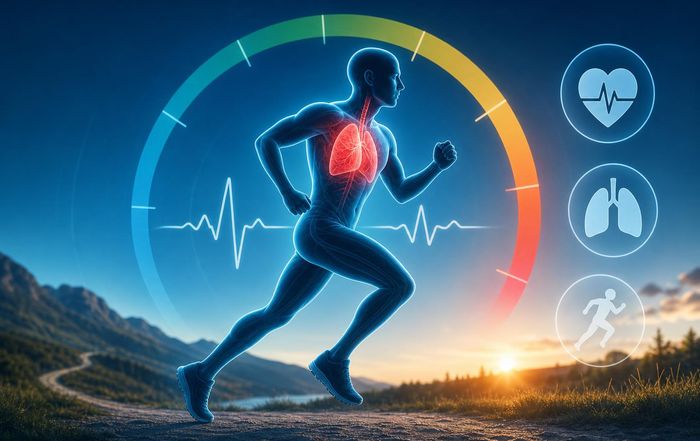
Conceptually, VO₂ max integrates several systems: the lungs must bring oxygen into the blood; the heart must pump that blood efficiently; the blood must carry oxygen (largely determined by hemoglobin and blood volume); and the muscles must extract and use the oxygen via mitochondria. Any limitation in this chain-poor lung function, cardiovascular disease, low hemoglobin, or untrained muscles-can reduce VO₂ max. That is why VO₂ max is not just a performance metric; it is also closely linked to overall health and mortality risk, as highlighted by research summarized by bodies like the World Health Organization (WHO) and American Heart Association (AHA).
Why VO₂ Max Matters for Performance and Health
For endurance performance, VO₂ max sets an upper ceiling on how much aerobic power an athlete can generate. In sports such as distance running, cycling, rowing, and cross-country skiing, elite competitors typically have very high VO₂ max values compared with the general population. However, among well-trained athletes, VO₂ max alone does not determine who wins races. Other factors-such as lactate threshold, running economy, tactical skills, and psychological resilience-become equally or more important.
From a health perspective, the story is clearer. Large epidemiological studies have shown that higher cardiorespiratory fitness is associated with substantially lower all-cause and cardiovascular mortality, independent of traditional risk factors like smoking status, blood pressure, or cholesterol. The Cooper Institute (cooperinstitute.org) and other research centers have tracked tens of thousands of people over decades and found that people with higher fitness levels lived longer and had fewer chronic diseases. VO₂ max, or a validated estimate of it, is often the measure used to quantify this fitness.
This is one reason many health and sports organizations now refer to low cardiorespiratory fitness as a major modifiable risk factor, similar in importance to smoking or hypertension. Improving VO₂ max through regular aerobic training can help reduce the risk of heart disease, type 2 diabetes, certain cancers, and cognitive decline. For people who are already active, a higher VO₂ max often translates into being able to perform daily tasks with less effort, recover faster between bouts of activity, and tolerate more demanding training loads in sports or in the gym.
For readers interested in broader health implications beyond performance, our health and wellness sections frequently explore how cardiorespiratory fitness interacts with stress, sleep, and chronic disease.
Typical VO₂ Max Ranges and What Counts as "Good"
VO₂ max values vary widely based on age, sex, genetics, training history, altitude, and body size. Reference tables from organizations such as the American College of Sports Medicine and national health agencies like the National Institutes of Health (NIH) provide normative ranges for different age groups. While exact cut-offs differ by source, some broad patterns are consistent.
Young, untrained adult men often fall somewhere in the range of about 35-45 ml/kg/min, while untrained adult women might fall roughly in the 27-38 ml/kg/min range. As age increases, average values decline, partly due to changes in heart function, muscle mass, and activity levels. For example, a VO₂ max of 40 ml/kg/min might be considered "above average" for a man in his 40s but "average" or even "below average" for a highly trained 20-year-old male endurance athlete. Elite male endurance athletes may exceed 70-80 ml/kg/min, and elite female endurance athletes may reach 60-70 ml/kg/min or more, according to data collated by sports science institutions such as Aspetar (aspetar.com) and university exercise physiology labs.
It is important, however, not to fixate on a single threshold as "good" or "bad." For health outcomes, relative position within your age and sex group matters, but so does the trend over time. If someone moves from "poor" to "fair," or from "fair" to "good," their health risk profile improves, even if they never approach elite numbers. The U.S. Centers for Disease Control and Prevention (CDC) and NHS in the UK (nhs.uk) emphasize that any improvement in physical activity and fitness is beneficial, especially for people starting from low levels of activity.
For athletes, the context is different. A runner trying to improve their 10K time might use VO₂ max as one element in setting training paces, but their race performance over time is often a more meaningful outcome measure than a lab value. For recreational exercisers, being able to hike longer without getting winded or complete a workout with less fatigue can be more relevant than reaching a specific VO₂ max target.
Readers who want to translate VO₂ max into training zones or performance goals may find our training and physical sections helpful, where concepts like heart-rate zones, pace-based workouts, and strength integration are explored in more detail.
How VO₂ Max Is Measured in Labs vs. Wearables
In a clinical or sports performance lab, VO₂ max is measured directly via gas analysis during a maximal exercise test. This method requires specialized equipment, trained staff, and controlled conditions, which is why it is often reserved for athletes, research studies, or people undergoing medical evaluation. Organizations like Mayo Clinic (mayoclinic.org) and Cleveland Clinic (my.clevelandclinic.org) use similar cardiopulmonary tests when assessing patients with heart or lung disease.
Most people, however, encounter VO₂ max through estimates generated by smartwatches, fitness trackers, or smartphone apps. Devices from brands such as Garmin, Apple, Polar, and Coros use algorithms based on heart rate responses, speed, power output (for cycling), and personal data like age, sex, and weight. Many of these algorithms are built on research from companies such as Firstbeat (now part of Garmin), which validated their models against lab tests in various populations.
Despite this, wearable-derived VO₂ max is still an estimate, not a direct measurement. It can be influenced by factors such as:
Poor heart rate signal quality (for example, due to wrist movement, tattoos, or cold weather).
Incorrect user data (age, weight, maximum heart rate).
Environmental conditions (heat, humidity, altitude).
Type and intensity of the activity used for estimation.
Studies published through academic platforms like PubMed (pubmed.ncbi.nlm.nih.gov) suggest that some devices can provide reasonably accurate group-level estimates in healthy adults, but individual error margins can be significant-often in the range of ±5 ml/kg/min or more. That can mean the difference between an "average" and "excellent" classification in some charts.
The practical takeaway is that wearable VO₂ max can be useful for tracking trends-whether your aerobic fitness is improving, stable, or declining-rather than as an exact clinical number. For those interested in the science of measurement and technology in training, our technology and sports coverage often looks at how devices and metrics can support performance without replacing sound coaching and self-awareness.
Key Physiological Factors That Influence VO₂ Max
VO₂ max is shaped by a mix of genetic, biological, and lifestyle factors. Understanding these can help set realistic expectations and guide training choices.
Genetics plays a substantial role. Twin and family studies, including work summarized by organizations such as the National Heart, Lung, and Blood Institute (NHLBI), suggest that 20-50% of the variation in VO₂ max between individuals may be explained by inherited traits. Some people start with a relatively high baseline VO₂ max and respond strongly to training, while others see more modest gains even with consistent effort. This does not mean training is futile; it simply means that not everyone can reach the same absolute numbers.
Heart size and function are also crucial. A larger, stronger heart can pump more blood per beat (stroke volume), which increases cardiac output and therefore the delivery of oxygen to working muscles. Endurance training can induce beneficial adaptations such as increased stroke volume, mild enlargement of the left ventricle, and expanded blood volume. These changes are part of what sports cardiologists call "athlete's heart," a generally healthy adaptation distinct from pathological heart enlargement.
On the muscular side, factors like capillary density (tiny blood vessels that supply muscles), mitochondrial content (the "powerhouses" of cells that use oxygen to produce ATP), and the proportion of slow-twitch vs. fast-twitch muscle fibers all influence how effectively muscles can extract and use oxygen. Endurance training stimulates more capillaries and mitochondria, enhancing the muscles' oxidative capacity. Nutrition, including adequate iron status, also matters, because hemoglobin in red blood cells carries oxygen; iron deficiency can lower VO₂ max even if training is otherwise solid. Resources from World Athletics (worldathletics.org) and national sports institutes frequently highlight the importance of screening for low iron in endurance athletes, especially in women.
Age and sex differences are also consistent. VO₂ max tends to peak in late adolescence or early adulthood and gradually declines with age, typically by about 5-10% per decade after age 30 in sedentary people. Regular training can slow this decline significantly. On average, women have lower VO₂ max values than men due to differences in body composition, hemoglobin levels, and heart size, but within each sex there is a wide range, and highly trained women often outperform untrained men in absolute performance.
Lifestyle factors-especially physical activity level, smoking status, and body composition-may be the most modifiable. Sedentary behavior leads to reductions in stroke volume, blood volume, and mitochondrial density, all of which lower VO₂ max. Conversely, sustained aerobic training can increase VO₂ max by 10-30% or more in previously untrained individuals over several months, as reflected in guidelines from the American College of Sports Medicine and World Health Organization.
For readers exploring broader training and lifestyle changes, our fitness and nutrition sections provide complementary guidance on building sustainable habits that support both performance and health.
How Training Can Improve VO₂ Max
While genetics and age set some boundaries, VO₂ max is highly trainable, especially if you are new to structured exercise. The most effective strategies generally combine consistent aerobic volume with strategically placed higher-intensity work.
Steady-state aerobic training at moderate intensity-often described as being able to talk in short sentences but not sing comfortably-forms the foundation. This type of training improves stroke volume, capillarization, and mitochondrial density without excessive fatigue. For many people, this might involve brisk walking, easy running, cycling, swimming, or rowing for 30-60 minutes on most days of the week. Public health guidelines from organizations like the WHO recommend at least 150-300 minutes of moderate-intensity aerobic activity per week, which aligns well with maintaining or modestly improving VO₂ max.
To push VO₂ max higher, especially once a base level of fitness is established, higher-intensity interval training (HIIT) is often used. Classic VO₂ max intervals might involve 3-5 minutes of hard effort (around 90-100% of maximal heart rate or close to 5K-10K race pace for runners), repeated several times with equal or slightly shorter recovery periods. These sessions stress the cardiovascular system near its limits, encouraging adaptations in stroke volume and oxygen utilization. Shorter intervals (for example, 30 seconds to 2 minutes) at high intensity can also be effective, particularly for time-crunched exercisers.
However, more intensity is not always better. HIIT is demanding and can increase injury risk, especially in people with limited training history or underlying health conditions. Most endurance coaches and sports science bodies recommend that the majority of training-often 70-80%-be done at low to moderate intensities, with only a small proportion at very high intensities. This "polarized" or "80/20" approach has been observed in many elite endurance athletes and is supported by research summarized by institutions such as Norwegian School of Sport Sciences (nih.no).
Strength training, while not a primary driver of VO₂ max, indirectly supports aerobic performance by improving muscle function, resilience, and running economy. Maintaining lean mass also helps keep relative VO₂ max (per kilogram of body weight) from declining due to increases in fat mass. Integrating two or three strength sessions per week, focusing on major muscle groups, can complement aerobic training, a topic often explored in our lifestyle and fitness coverage.
Before starting intense training, especially if you have cardiovascular risk factors or symptoms such as chest pain, unexplained shortness of breath, or dizziness, consulting a healthcare professional is strongly advised. Organizations like the AHA and ESC provide screening recommendations that clinicians use to decide when formal testing is appropriate.
VO₂ Max vs. Other Fitness Metrics: How Much Should You Care?
With so many metrics now available-from heart-rate variability and lactate threshold to training load and recovery scores-it is easy to become overwhelmed. VO₂ max is valuable, but it is only one piece of the fitness puzzle.
Lactate threshold (or ventilatory threshold) often predicts endurance performance better than VO₂ max in trained athletes because it reflects the intensity you can sustain for a prolonged period. Running economy or movement efficiency-how much oxygen you use at a given pace-is another crucial determinant of performance. Two runners with identical VO₂ max values may perform very differently if one is more economical. For strength and power sports, metrics such as one-repetition maximum, peak power, and rate of force development matter more than VO₂ max.
For general health, simple measures like resting heart rate, ability to climb stairs without undue breathlessness, and adherence to weekly physical activity guidelines can be just as informative on a practical level. The WHO and CDC emphasize total activity volume and intensity rather than VO₂ max per se, because large-scale measurement of VO₂ max is not feasible in public health settings.
Wearables that estimate VO₂ max can still be useful, especially when used alongside other data. If your VO₂ max estimate is slowly rising while your resting heart rate is decreasing and your workouts feel easier, that suggests your cardiovascular system is adapting positively. If your VO₂ max is flat or declining while your perceived effort climbs and recovery feels poor, it may signal overtraining, illness, or other issues.
Ultimately, VO₂ max is most helpful when interpreted in context: your goals (health vs. competition), your sport, your age, and your training history. For some, it will be a central performance metric; for others, a background indicator that confirms they are heading in the right direction.
Putting VO₂ Max to Work in Your Own Training
For active people and athletes, the most practical use of VO₂ max is as a guide rather than a verdict. If you have a lab-tested VO₂ max result, a coach or sports scientist can use it to help define heart-rate zones, power targets, or paces that correspond to different training intensities. This can make your sessions more specific and efficient. If you rely on a wearable estimate, you can still use the associated fitness levels and suggested zones as a starting point, adjusting them based on how you actually feel during workouts.
Tracking changes over months rather than days is important. VO₂ max does not jump dramatically from one week to the next in trained individuals. Instead, look for gradual trends and consider them alongside subjective factors such as energy levels, enjoyment of training, and performance in your chosen activities. For recreational exercisers, noticing that your estimated VO₂ max rises as you progress from walking to run-walking to sustained running can be a powerful motivator.
For those building a well-rounded program, combining VO₂ max-oriented training with strength work, mobility, and recovery practices tends to produce better long-term outcomes than pursuing aerobic fitness alone. Our wellness and events daily content often highlights how community races, charity rides, or group fitness challenges can provide structure and social support for this kind of holistic approach.
Most importantly, VO₂ max should be seen as a dynamic, modifiable characteristic rather than a fixed label. Even modest improvements can translate into meaningful gains in daily function, resilience, and long-term health. Whether your goal is to run your first 5K, keep up with your kids, or simply feel less winded on the stairs, understanding VO₂ max can help you use training time more effectively-without letting a single number define your fitness.