

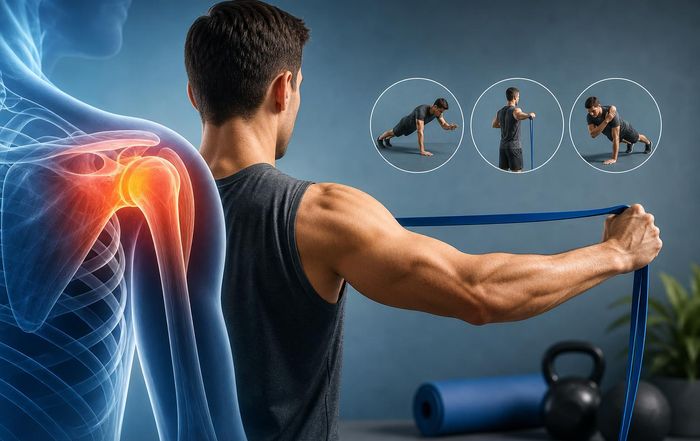
How to Improve Shoulder Stability With Simple Exercises
Shoulder pain and "cranky" shoulders are common in everyone from desk workers to heavy lifters and overhead athletes. Often, the problem is not a lack of strength but a lack of stability: the ability of the shoulder joint and surrounding muscles to control movement, resist unwanted motion, and keep the joint centered and supported during daily tasks and training.
This guide breaks down what shoulder stability actually means, why it matters for performance and long-term joint health, and how to build it with simple exercises that can be done at home or in the gym-without turning your workouts into a rehab clinic session.
What shoulder stability really means
The shoulder is the most mobile joint in the body, but that freedom comes at a cost. The ball of the upper arm (humerus) sits in a relatively shallow socket on the shoulder blade (glenoid), relying heavily on muscles, tendons, and connective tissue to keep it stable. When those structures are weak, poorly coordinated, or overloaded, the result can be pain, pinching, or a feeling of "looseness" or weakness during pressing, pulling, or overhead movements.
Stability is not just about "tight" muscles or strong deltoids. It involves the coordinated action of several key players:
The rotator cuff (supraspinatus, infraspinatus, teres minor, subscapularis) centers the ball in the socket and controls rotation.
The scapular stabilizers (lower and middle trapezius, rhomboids, serratus anterior) control how the shoulder blade moves on the ribcage.
The core and trunk provide a stable base so the shoulder is not forced to compensate.
The capsule and ligaments of the joint provide passive stability, especially at extremes of motion.
Organizations such as the American Academy of Orthopaedic Surgeons and American Physical Therapy Association emphasize that many common shoulder problems-like impingement, rotator cuff tendinopathy, and recurrent strains-are linked to poor scapular control and rotator cuff dysfunction rather than simply "weak shoulders" overall. You can explore more background through resources from AAOS and APTA. The good news is that targeted, relatively simple exercises can significantly improve how these structures work together, often reducing pain and improving performance in both everyday life and sports.
When shoulder stability work is especially important
Almost everyone can benefit from shoulder stability training, but it is particularly valuable if you:
Do a lot of overhead work (pain with reaching up, putting things on shelves, hanging curtains).
Lift weights regularly, especially bench press, overhead press, pull-ups, or Olympic lifts.
Play overhead or throwing sports such as tennis, volleyball, baseball, handball, or swimming.
Spend long hours at a desk or laptop, especially with rounded shoulders and forward head posture.
Have a history of shoulder injuries, including dislocations, rotator cuff strains, or labral tears (with clearance from a medical professional).
If you have persistent or sharp pain, night pain that wakes you, noticeable weakness, or a history of traumatic injury, it is wise to consult a qualified healthcare professional-such as a sports physician, physical therapist, or orthopedic specialist-before starting or progressing a new program. Organizations like the National Health Service in the UK and the Mayo Clinic publish accessible resources on shoulder pain and red-flag symptoms at nhs.uk and mayoclinic.org.
For fans interested in broader joint-friendly programming, the daily training and exercise content at our fitness, training, and physical sections can help you build stable shoulders into a balanced routine.
Principles for safer, more effective shoulder stability training
Before getting into specific exercises, a few principles make the work safer and more productive:
Prioritize control over load. Stability exercises are about precision and quality of movement, not chasing heavy weights. Light resistance bands, small dumbbells, or just bodyweight are often enough.
Work within a pain-free range. Mild muscular fatigue or "effort" is fine, but sharp, catching, or radiating pain is a sign to stop or modify. Painful compensations reinforce poor patterns.
Train the shoulder blade, not just the shoulder joint. Many people focus only on the deltoids or chest. Effective stability training integrates the scapula and trunk.
Use high frequency, low volume. For most, 2-4 sets of 8-15 controlled reps, 3-5 times per week, works better than a single "shoulder day" with lots of volume.
Progress gradually. Start with easier variations and only move on when you can perform them with consistent form and no pain.
If you are integrating this work into a broader health program, you can also explore our health and wellness sections for recovery, sleep, and stress-management strategies that support joint health.
Simple scapular control exercises
Scapular (shoulder blade) control is often the missing piece in shoulder stability. Many people have "winging" shoulder blades or limited upward rotation when they raise their arms, which can narrow the space under the acromion and contribute to impingement-type pain.
1. Scapular setting against a wall
This is a foundational drill to reconnect with shoulder blade position and gentle activation.
Stand with your back against a wall, feet about 15-30 cm away, knees softly bent. Place the back of your head, upper back, and pelvis on the wall. Let your arms rest at your sides with palms facing forward. Gently draw your shoulder blades slightly down and together, as if you were sliding them into your back pockets, without arching your lower back or thrusting your ribs forward. Hold for 5-10 seconds, breathing normally, then relax.
Aim for 8-10 repetitions, 1-2 times per day. The goal is subtle control, not maximal squeezing. Over-pulling the shoulders back can create tension and poor mechanics, especially if you already have a stiff upper back.
2. Wall slides (scapular upward rotation)
Wall slides help re-train the shoulder blade to rotate upward and glide smoothly as the arm lifts-essential for pain-free overhead motion.
Stand with your back and head against a wall. Bend your elbows to 90 degrees and place the backs of your hands and forearms against the wall in a "goalpost" or "W" position. Maintaining light contact of your arms and shoulder blades with the wall, slowly slide your arms up toward a "Y" shape, stopping before any pain or shrugging. Think of your shoulder blades rotating upward and outward, not just your hands moving.
Lower with control and repeat for 8-12 reps. If you cannot keep your arms on the wall without arching your back, step slightly away from the wall or reduce the range. Over time, this exercise can improve scapular upward rotation and reduce compensatory neck tension.
Resources from organizations like Physio-Pedia and Cleveland Clinic discuss scapular dyskinesis (abnormal shoulder blade motion) and its link to shoulder pain; you can explore more at physio-pedia.com and clevelandclinic.org, though always follow guidance from your own clinician if you are under care.
Rotator cuff strengthening with minimal equipment
The rotator cuff's job is not to produce big, visible movement but to keep the humeral head centered and controlled in the socket during motion. Targeted strengthening can improve both pain and function, especially for overhead tasks.
3. Side-lying external rotation
This classic exercise is widely used in rehabilitation and performance programs because it isolates the external rotators without heavy loads.
Lie on your side with the working arm on top, elbow bent to 90 degrees and resting against your side, forearm across your abdomen. Hold a light dumbbell (often 0.5-2.5 kg is plenty to start). Keeping your elbow pinned to your side, rotate your forearm upward, moving the hand away from your body, until you feel a gentle effort in the back of your shoulder. Pause briefly, then lower slowly.
Perform 2-3 sets of 10-15 reps, 3-4 times per week. If you cannot control the movement without your shoulder rolling backward or your elbow drifting, reduce the weight or range. Research summarized by organizations like ShoulderDoc and Massachusetts General Hospital suggests that side-lying external rotation produces high activation of the infraspinatus and teres minor with relatively low joint stress; their websites at shoulderdoc.co.uk and massgeneral.org offer additional clinician-oriented detail.
4. Band external and internal rotations (standing)
Resistance bands are convenient for home or travel and allow you to adjust difficulty easily.
Anchor a light band at elbow height (door handle, sturdy post). Stand sideways to the anchor, elbow bent 90 degrees and pinned to your side, forearm across your body. For external rotation, step away to create slight tension with your hand near your belly. Rotate your forearm outward, away from your body, without letting your elbow leave your side or your torso twist. Slowly return.
Turn around to face the opposite direction for internal rotation: start with your forearm out to the side and pull across your body. Use a slow tempo (2-3 seconds up, 2-3 seconds down) and stop well before pain. Try 2-3 sets of 10-15 reps each direction.
Keep your shoulder relaxed away from your ear, ribs stacked over pelvis, and avoid excessive trunk rotation. For more shoulder-friendly band and bodyweight programming, see the strength content in our fitness and training sections.
Building stability through closed-chain exercises
In "closed-chain" exercises, your hand is fixed on a surface (floor, wall, bar), and your body moves around it. This setup often feels safer and more stable for irritated shoulders and trains the entire kinetic chain-wrist, elbow, shoulder, and trunk-together.
5. Quadruped rocking (weight-bearing scapular control)
Start on hands and knees with hands under shoulders and knees under hips. Spread your fingers and press gently into the floor, feeling a light "push" through the shoulder blades without rounding your upper back excessively. From this stable position, slowly rock your body forward and backward a few centimeters, keeping your elbows straight and your neck relaxed.
The goal is to feel your shoulder blades gliding smoothly on your ribcage as your weight shifts, without collapsing at the top of the shoulders. Perform 2-3 sets of 15-20 controlled rocks. If this is uncomfortable on the wrists or shoulders, you can elevate your hands on a bench or do the movement against a wall.
6. Elevated plank holds
Planks are a simple way to train shoulder and core stability together, which is crucial for safe pressing and overhead work.
Place your hands on a bench, sturdy box, or wall. Walk your feet back until your body forms a straight line from head to heels. Press the floor or bench away slightly so your shoulder blades are stable and not collapsing. Engage your core and glutes lightly, keep your neck neutral, and hold for 15-30 seconds.
Start with 2-3 sets and gradually increase hold time or lower the hands (to a lower bench, then the floor) as your control improves. If you feel strain in the front of the shoulder, try narrowing your hand position slightly or shifting your weight a little back toward your feet.
Guidance from organizations like ACE (American Council on Exercise) and NSCA (National Strength and Conditioning Association) at acefitness.org and nsca.com can help you integrate these drills into broader strength programs.
Dynamic stability: progressing toward functional patterns
Once basic control is in place, dynamic stability exercises help the shoulder handle real-world demands-reaching, lifting, throwing, and reacting to unexpected forces.
7. Farmer's carries with shoulder "packing"
Loaded carries are a simple way to train shoulder, grip, and trunk stability simultaneously.
Hold a dumbbell or kettlebell in one or both hands at your sides. Stand tall, gently "pack" your shoulders by drawing them slightly down and back (without over-shrugging or arching your back), and walk slowly for 20-40 meters. Keep your ribs stacked, avoid leaning heavily to one side, and resist the weight pulling your shoulder into a slump.
Start with a light load you can carry comfortably while maintaining good posture. As your stability improves, you can progress to single-arm carries, which challenge the trunk and shoulder more intensely on one side. These can be integrated into a broader strength routine alongside other compound lifts; for ideas on structuring such sessions, see our sports and lifestyle coverage.
8. Wall "alphabet" or small-range circles
This drill trains the shoulder to maintain stability while the arm moves through small, controlled patterns.
Stand facing a wall, arm out in front of you at shoulder height, elbow slightly bent. Place a small ball (like a soft tennis ball) or your fist against the wall. Apply light pressure into the wall to engage the shoulder. Maintaining that pressure, draw small circles or trace letters of the alphabet on the wall, keeping the movement coming from the shoulder rather than the wrist.
Perform for 20-40 seconds per arm, 2-3 rounds. Keep the range small and pain-free. If you feel neck tension, lower the arm slightly or reduce the duration. This type of low-load, high-control exercise is often used in sports rehabilitation settings to prepare athletes for return to play.
How to structure a simple shoulder stability "mini-routine"
You do not need a long, complex program to benefit from these exercises. A concise routine performed 3-5 times per week can meaningfully improve comfort and control. Here is a sample template that can be added to the start or end of a workout, or done on its own in 10-20 minutes:
Scapular setting against a wall - 2 sets of 8-10 holds (5-10 seconds each)
Wall slides - 2 sets of 8-12 reps
Side-lying external rotation - 2-3 sets of 10-15 reps each arm
Quadruped rocking - 2 sets of 15-20 rocks
Elevated plank holds - 2-3 sets of 20-30 seconds
Optional: Farmer's carries - 2-3 carries of 20-40 meters
If you are already following a strength or sports program, you can treat this as a "movement prep" circuit before upper-body days or as a separate low-intensity session on off days. For broader planning ideas, including how to balance strength, conditioning, and mobility, see the training resources available in our fitness and training sections, and the performance-oriented features in sports.
Common mistakes that undermine shoulder stability work
Even simple exercises can become less effective-or risky-if performed with poor habits. A few pitfalls to watch for:
Rushing through reps. Stability training is about control. Fast, jerky movements often bypass the stabilizers and reinforce compensations.
Using too much weight. If your form breaks down, your shoulder hikes toward your ear, or you need to twist your torso to complete reps, the load is too heavy.
Ignoring the neck and ribs. Excessive neck tension or rib flaring often signals that the shoulder is not doing its job. Keep your neck long and ribs stacked over your pelvis.
Training only in one plane. Real-world tasks involve reaching, rotating, and moving diagonally. Over time, include exercises that challenge multiple directions, not just straight up and down.
Skipping warm-up and recovery. Cold, stiff tissues are more vulnerable. A brief general warm-up, plus regular mobility work and adequate sleep and nutrition, support shoulder health. Our nutrition and wellness sections cover recovery-supportive habits from food to stress management.
External resources such as the World Health Organization at who.int and national health bodies like the U.S. Centers for Disease Control and Prevention at cdc.gov offer broader guidance on physical activity and musculoskeletal health, which can provide a useful big-picture framework alongside specific shoulder work.
When to seek professional help
While many mild shoulder issues respond well to stability training and load management, some signs suggest you should seek individualized assessment:
Sudden onset of severe pain after a fall, collision, or heavy lift.
Visible deformity, inability to lift the arm, or a feeling of the joint "slipping out."
Persistent pain that does not improve after a few weeks of modified activity and light exercise.
Night pain that consistently wakes you or prevents you from lying on the affected side.
Progressive weakness, numbness, or tingling down the arm.
In such cases, prompt evaluation by a sports medicine physician, orthopedist, or physical therapist is important. National organizations like the American Academy of Orthopaedic Surgeons (aaos.org), APTA (apta.org), and reputable clinics such as Mayo Clinic (mayoclinic.org) and Cleveland Clinic (clevelandclinic.org) can help you understand typical diagnostic pathways and treatment options, though local care providers should guide your personal plan.
Bringing it all together
Improving shoulder stability does not require complicated equipment, long rehab sessions, or giving up your favorite lifts and sports. By focusing on scapular control, targeted rotator cuff strengthening, and integrated closed-chain and dynamic stability drills, most people can build more resilient, better-behaving shoulders in just a few short sessions per week. Consistency and patience matter more than intensity. Start with low-load, pain-free movements, pay attention to quality and control, and progress gradually. Combined with thoughtful overall training, good recovery habits, and, when needed, professional guidance, these simple exercises can help keep your shoulders strong, stable, and ready for whatever your life and sport demand.