

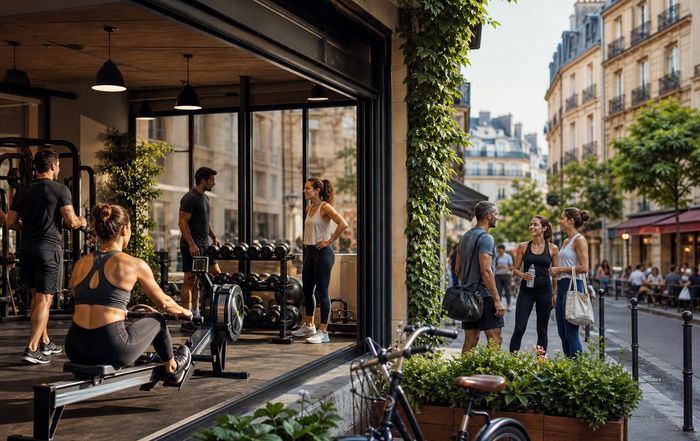
What Sets French Neighborhood Fitness Clubs Apart
French fitness culture is often associated with chic boutique studios in Paris or elite country clubs on the Riviera, but the backbone of everyday movement in France is far more local and democratic. Across cities, suburbs, and small towns, neighborhood fitness clubs-known variously as associations sportives, clubs de quartier, or simply la salle du coin (the gym on the corner)-play a distinctive role in how people stay active, socialize, and connect with their communities.
For readers accustomed to big-box chains or app-based home workouts, these clubs can look surprisingly different. Their structure, pricing, atmosphere, and even their purpose reflect broader French attitudes toward health, leisure, and public life. Understanding what sets them apart offers useful lessons for anyone thinking about sustainable fitness habits, community sport, or how urban design can support healthier lifestyles.
In this page, we explore what makes French neighborhood fitness clubs unique: from their non-profit roots and social mission to the way they blend structured training with everyday conviviality.
A tradition of non-profit sport, not just commercial gyms
One of the most distinctive features of French neighborhood fitness is the central role of non-profit associations. Under France's 1901 law on associations, it is easy and inexpensive for residents, municipalities, or groups of coaches to form a non-profit sports club. Many local gyms and training groups are legally associations rather than companies, even when they feel "professional" to participants.
National federations such as the Fédération Française d'Éducation Physique et de Gymnastique Volontaire (FFEPGV) focus specifically on accessible, community-based exercise for all ages, while broader sport bodies like the Comité National Olympique et Sportif Français (CNOSF) coordinate thousands of local clubs across disciplines. This association model means that a neighborhood fitness club may be run by volunteers, elected boards, and part-time coaches, with any surplus reinvested into equipment, facility improvements, or reduced membership fees rather than distributed as profit.
This structure shapes the experience in subtle ways. The front desk might be staffed by a member doing a volunteer shift. The annual general meeting is open to all, and members can vote on fees or new classes. Municipalities often support these clubs with subsidized facility access, grants, or co-funding for renovations. Compared with purely commercial gyms, the emphasis tends to fall more on inclusion and participation than on sales targets or upselling premium services. For visitors used to highly branded international chains, the result can feel slightly less polished-but often more personal and rooted in the neighborhood.
Community first: social ties as a core training tool
French neighborhood fitness clubs are not just places to burn calories; they are also social hubs, particularly in smaller towns and outer-city districts. Sport in France has long been framed by public authorities as a tool for social cohesion. The Ministère des Sports et des Jeux Olympiques et Paralympiques explicitly links local clubs to goals such as public health, youth development, and integration across social backgrounds.
This policy philosophy shows up in everyday details. Many clubs encourage members to linger before or after sessions, with shared coffee corners, noticeboards advertising local events, and informal meetups. It is common for long-standing groups-like a Tuesday evening circuit-training class or a Sunday running group-to organize potlucks, charity events, or day trips. Some clubs partner with local schools or senior centers, bringing together different generations under the same roof.
For people who might feel intimidated by high-performance environments, this social fabric can be particularly important. Members are often greeted by name, and coaches tend to know who is coming back from injury, who is training for a race, and who is simply trying to move a bit more after a sedentary week. The line between "client" and "member of the association" is thinner than in many commercial gyms, and that can make it easier for beginners to stick with a program long enough to see real benefits. Readers interested in starting or maintaining an exercise habit will recognize how crucial this sense of belonging can be, something we often highlight in our broader coverage of fitness and wellness.
Affordable, predictable pricing shaped by public policy
Another factor that sets many French neighborhood clubs apart is relatively accessible pricing, especially when compared to major cities in North America or the UK. Because so many clubs are non-profit, receive municipal support, or share facilities with schools and community centers, membership fees are often set with affordability in mind rather than purely market demand.
Typical models include an annual membership fee plus a modest supplement per activity or class cycle. Discounts are commonly offered for students, unemployed members, families, and older adults. Some municipalities provide additional subsidies or "sport vouchers" for low-income households, administered locally or through national schemes such as the Pass'Sport, which helps young people from eligible families join clubs at reduced cost. Information about these initiatives is usually available through official portals like service-public.fr or the Ministry of Sports.
This approach reflects a broader French view of physical activity as part of public health, alongside healthcare and education. Organizations such as Santé publique France and the World Health Organization emphasize the long-term benefits of regular movement for preventing chronic disease, and French authorities have been increasingly explicit about using local clubs as a lever to increase activity levels. For many residents, especially outside of major metropolitan centers, a neighborhood association is the most practical and affordable way to access structured training, compared with more expensive boutique studios or private personal training.
For international readers, this model also highlights the importance of local policy and infrastructure in shaping real-world fitness options. It is not just about personal motivation; the way clubs are funded and governed can meaningfully change who gets to participate.
A strong emphasis on group classes and coached sessions
While large commercial gyms in many countries emphasize rows of cardio machines and 24/7 access, French neighborhood clubs are often built around scheduled group sessions. Whether it is functional training, Pilates, dance-inspired cardio, or strength circuits, the idea is that you show up at a specific time, train with others, and are guided by a coach.
This format owes a lot to the historical influence of gymnastics and physical education in France, as well as the structure of non-profit associations that hire qualified instructors on a session basis. It is also aligned with guidelines from organizations such as France Olympique and the European Commission, which have promoted supervised, safe, and inclusive physical activity programs at the local level.
For participants, the group-class model offers several advantages: built-in accountability, a clearer sense of progression, and professional oversight of technique and load. It can also make time management easier; you commit to a Tuesday 19:00 class rather than constantly negotiating with yourself about when to go. On the other hand, people who prefer flexible, solo workouts might find the fixed schedule limiting, especially in smaller towns where the timetable is narrower.
Many French clubs blend this group focus with access to basic strength and cardio equipment, but the equipment area is often smaller than in big-box gyms. The heart of the club remains the salle de cours (classroom), where music, coaching cues, and shared effort define the atmosphere. For readers exploring different training environments, this is closer to a community studio than a 24-hour chain, even when the club is physically located in a municipal sports complex.
Multigenerational programming and "sport for life"
A notable difference between French neighborhood clubs and many commercial gyms is how explicitly they program for multiple life stages. Rather than focusing primarily on young adults and middle-aged professionals, many local associations offer classes for children, teenagers, adults, and seniors under the same organizational roof.
Children might attend motor-skills and fun fitness sessions, often linked to school schedules. Teenagers can join strength and conditioning or mixed-sport classes that complement school physical education. Adults have access to everything from high-intensity interval training to yoga, while older adults may be offered adapted physical activity-gentler, medically informed sessions aimed at maintaining mobility, balance, and cardiovascular health. Medical organizations like Inserm and Haute Autorité de Santé have highlighted the importance of such programs for aging well and managing chronic conditions.
This "sport for life" approach is encouraged by public authorities and reflected in campaigns promoting daily movement rather than only competitive sport. It also fits the social mission of many associations: they are not just chasing the demographic that spends the most on fitness, but trying to serve the widest possible slice of their neighborhood. In practical terms, that means you might see a senior balance class finishing as a kids' parkour session sets up, all while a recreational running group gathers outside for intervals.
For families, this can be particularly convenient: parents and children may be able to train at the same venue on the same evening, each in age-appropriate sessions. It also reinforces the idea that movement is a normal, lifelong activity rather than a temporary project to "get in shape."
Integration with everyday life: walking, cycling, and urban design
French neighborhood fitness clubs are often embedded in walkable, mixed-use areas, rather than isolated in retail parks reachable only by car. In many cities and towns, they share space with schools, municipal sports halls, or community centers, and are reachable by foot, bicycle, or public transport. This integration reflects broader European and French planning traditions, as well as recent pushes for active mobility.
National data from agencies such as INSEE and initiatives supported by the Agence nationale de la cohésion des territoires highlight the role of local infrastructure in supporting active lifestyles. When your gym is a 10-minute walk from home and right next to the park where you already take your children, the friction of going to a class is significantly reduced. Many clubs also encourage members to arrive by bike or on foot, aligning with environmental and public-health goals.
This spatial integration often leads to a different rhythm of use compared with car-dependent gyms. Evening classes might be filled with people coming directly from work via public transport, while late-afternoon sessions are popular with school-age children who simply move from classroom to sports hall. Weekend mornings can become a neighborhood ritual, with parents chatting outside while children finish their activity. For readers interested in how environment shapes health behavior, French clubs illustrate how urban design and fitness culture reinforce each other.
The influence of French medical and public-health culture
France's strong public-health and medical institutions also leave their mark on neighborhood fitness. Over the past decade, the country has progressively recognized "sport sur ordonnance"-exercise on prescription-as a tool for managing chronic disease. Under certain conditions, physicians can prescribe adapted physical activity, delivered by qualified professionals, for patients with long-term conditions.
While reimbursement and implementation vary by region, this policy has encouraged closer collaboration between local clubs, healthcare providers, and public-health bodies. Municipalities, regional health agencies, and organizations such as Ameli (France's public health insurance portal) provide information and, in some cases, financial support for programs delivered through associations.
The result is that some neighborhood fitness clubs offer specific classes for people with conditions like diabetes, cardiovascular disease, or obesity, sometimes in partnership with hospitals or clinics. Coaches in these programs often hold specialized qualifications in activité physique adaptée and follow guidelines from bodies like Santé publique France and international organizations such as the World Health Organization.
For participants, this medical integration can increase confidence, especially for those who have been sedentary or are worried about exercising safely. It also underscores a broader cultural message: in the French context, fitness is not only about aesthetics or performance; it is increasingly framed as a component of healthcare and disease prevention, something we also emphasize in our health and nutrition coverage.
Balancing tradition with digital and global trends
Despite their strong roots in local association culture, French neighborhood fitness clubs are not insulated from global trends. Over the last several years, they have had to adapt to the rise of digital fitness, international boutique brands, and changing expectations around flexibility and convenience.
The COVID-19 pandemic accelerated this shift, pushing many clubs to experiment with online classes, livestreamed sessions, and digital booking tools. While large international platforms like Les Mills, Peloton, and Nike Training Club have a presence in France, local associations often adopt a hybrid approach: maintaining in-person community classes while offering basic digital options for members who cannot always attend on site.
At the same time, commercial chains-both French and international-have expanded aggressively with low-cost, high-volume models. These gyms typically emphasize extended opening hours, large equipment floors, and standardized branding. They appeal to younger, price-sensitive members and those who prefer solo training. French neighborhood clubs therefore find themselves competing not only on price but on experience: personalized coaching, social connection, and local identity.
Some associations have responded by professionalizing their communication, improving facilities, or adding more specialized classes like functional training, mobility work, or sport-specific conditioning. Others double down on their strengths: multigenerational programming, integration with schools, and partnerships with local events, which align well with trends we track in training and sports participation worldwide.
For active people considering where to train, this landscape means a wider choice: from ultra-modern, app-driven chains to deeply rooted local clubs where the atmosphere may be less polished but the sense of belonging stronger.
What other countries can learn from the French neighborhood model
Looking at French neighborhood fitness clubs from an international perspective, several elements stand out as potentially transferable to other contexts, even where legal and funding frameworks differ.
First, the association-based governance-with member involvement and non-profit status-helps keep the focus on participation and community benefit rather than short-term revenue. While not every country has a legal structure identical to France's 1901 associations, many have equivalents that could support similar models.
Second, the explicit integration of sport, public health, and social policy provides a clear rationale for public support. When ministries of health, sport, and urban planning align around local clubs as tools for preventing disease, improving social cohesion, and animating public spaces, it becomes easier to justify subsidies, facility access, or tax incentives. International bodies like the World Health Organization and the European Commission have repeatedly argued for such integrated approaches, and France offers one concrete example of how they can work on the ground.
Third, the emphasis on multigenerational, coached group activity addresses a common weakness of purely commercial gyms: the tendency to serve mainly already-active adults. By designing programs for children, older adults, and people with chronic conditions, French clubs broaden their reach and help embed movement across the lifespan.
Finally, the spatial integration of clubs into walkable neighborhoods, near schools and public transport, reduces barriers to participation. For cities and countries grappling with sedentary lifestyles, this is a reminder that fitness is not only a personal choice but also a function of how communities are built.
For readers who care about their own training as well as the bigger picture of public health and sport culture, French neighborhood fitness clubs offer a compelling case study. They show how policy, community, and everyday practice can come together to make movement a normal, shared part of local life-less about chasing perfection, more about showing up, together, week after week.