

Pool Workouts for People Returning to Exercise: Safe, Joint-Friendly Ways to Get Moving Again
Re-starting exercise after a break-whether due to injury, illness, pregnancy, stress, or simply life getting in the way-can feel intimidating. Pool workouts offer a way back that is gentle on joints while still challenging your heart, lungs, and muscles. Thanks to water's buoyancy and resistance, you can rebuild fitness with less impact and often less pain than on land, which is why aquatic exercise is frequently recommended by physiotherapists and sports medicine clinicians worldwide.
This guide focuses on practical, evidence-informed pool routines for people returning to exercise at different levels, from cautious beginners to those ready for more intensity. It also highlights safety considerations, how to progress sensibly, and how to combine pool training with other forms of movement such as strength work and walking. Readers who are currently inactive, managing chronic conditions, or coming back from injury should view this as a menu of options to discuss with a healthcare professional rather than a one-size-fits-all prescription.
For more ideas on rebuilding fitness beyond the pool, you may also find the training coverage at FitBuzzFeed's training section and the general fitness hub helpful.
Why Water Is So Useful When You're Coming Back
Water changes how your body experiences load and movement. In chest-deep water, your body effectively weighs far less than on land, which significantly reduces impact forces through ankles, knees, hips, and spine. Organizations such as the American Council on Exercise highlight that buoyancy can decrease weight-bearing stress by up to half or more depending on depth, helping people move more comfortably after time off or injury. At the same time, water provides uniform resistance in all directions, meaning that every movement becomes a light strengthening exercise.
This combination is why aquatic exercise is widely used in rehabilitation and return-to-sport programs. The American College of Sports Medicine at https://www.acsm.org/ and many national physiotherapy associations note that water-based workouts can improve cardiovascular fitness, muscular endurance, and flexibility, often with lower perceived exertion. For people with osteoarthritis, lower back pain, or excess body weight, this can make the difference between tolerating movement and avoiding it.
Another advantage is temperature regulation. Many pools are maintained around 27-29°C (80-84°F), which helps dissipate heat during exercise and can feel more comfortable than hot outdoor environments. That said, longer or more intense sessions, especially in warmer pools, still require attention to hydration and fatigue. For readers interested in broader health context, official bodies such as the World Health Organization at https://www.who.int/ and the U.S. Centers for Disease Control and Prevention at https://www.cdc.gov/ emphasize the importance of regular moderate activity for reducing chronic disease risk, and pool-based exercise counts fully toward those activity targets.
Water also has a psychological benefit. For many people, the pool feels less intimidating than a gym loaded with heavy equipment, and the novelty of aquatic movement can make workouts feel more playful. This can be especially valuable when motivation is fragile after a long break. For more on the mental and emotional side of healthy living, the wellness section and lifestyle coverage offer additional context.
Safety First: When to Get Clearance and How to Start
Before diving into specific workouts, it is important to understand when medical clearance is recommended. Guidelines from organizations such as the American Heart Association at https://www.heart.org/ suggest that people with known cardiovascular disease, significant risk factors, or recent major illness or surgery should discuss exercise plans with their healthcare provider. The same applies if you are pregnant, undergoing cancer treatment, or managing conditions like uncontrolled diabetes, severe arthritis, or balance disorders.
Even for those without major health issues, a cautious approach is wise when returning after a long break. A useful rule is to start at a level that feels easier than you think you can handle. Early sessions should emphasize technique, comfort in the water, and learning how your body responds. Fatigue, dizziness, chest pain, or unusual shortness of breath are signals to stop and seek advice. People with joint replacements or specific injuries should also confirm which movements are safe with a physiotherapist or sports medicine physician; organizations such as the Chartered Society of Physiotherapy at https://www.csp.org.uk/ and the American Physical Therapy Association at https://www.apta.org/ provide general educational material on aquatic rehab.
Pool safety basics matter as well. Choose a facility with qualified lifeguards and follow local rules. If your swimming skills are limited, stay in the shallow end and consider using a flotation belt or noodle. Never exercise alone if you have a history of fainting, seizures, or serious heart rhythm problems. Make sure you know where safety equipment and exits are located, and if you are new to swimming, basic instruction from a certified coach can quickly improve confidence and efficiency.
Finally, respect your current fitness level. For many people restarting exercise, 15-20 minutes of gentle movement in the pool is a solid beginning. The aim in the first few weeks is consistency, not intensity. The broader health section regularly emphasizes that building sustainable habits is more impactful over time than any single "hard" workout.
Warm-Up and Mobility: Your Non-Negotiable First 10 Minutes
Even though water cushions impact, a deliberate warm-up prepares muscles, joints, and the cardiovascular system. Skipping it is one of the easiest ways to turn a gentle return into a setback. A structured 8-10-minute warm-up can also serve as a stand-alone session on days when you feel tired but still want to move.
A simple sequence in waist- to chest-deep water might start with slow walking across the pool for 3-4 minutes, gradually increasing stride length. The water's resistance encourages you to lift your feet and engage the hips without jarring the joints. Follow this with 2-3 minutes of side steps and gentle backward walking, which challenge different muscle groups and begin to wake up stabilizing muscles around the knees and ankles. Holding the pool edge, you can then perform slow leg swings forward and backward, and gentle hip circles, staying well within a comfortable range of motion.
Upper-body mobility can be added with arm circles, shoulder rolls, and slow "breaststroke" arm sweeps while standing. Because water provides light resistance, keep these movements controlled rather than forceful, focusing on smooth arcs and relaxed breathing. This approach aligns with recommendations from organizations such as NHS Inform in the UK at https://www.nhsinform.scot/, which emphasizes gradual warm-ups and controlled range-of-motion exercises, especially for people managing joint issues or returning from injury.
If you are planning a longer swim or more vigorous aqua fitness session, consider adding 3-5 minutes of easy, continuous movement in the form you will be using-very gentle swimming, water jogging, or basic aqua aerobics patterns. This not only prepares the relevant muscles but also gives you a chance to check in with your breathing and comfort level before increasing effort. Over time, you can treat the warm-up as a diagnostic: if it feels unusually hard, that may be a sign to keep the session lighter.
Shallow-Water Walking and Jogging: The Easiest Way Back
For many people returning to exercise, shallow-water walking is the most accessible starting point. It does not require strong swimming skills, can be done in almost any public pool, and closely mimics everyday movements like walking and climbing stairs, making it directly relevant to daily function. This type of workout is particularly suitable for those with knee or hip osteoarthritis, post-partum individuals cleared for activity, and anyone whose primary goal is simply to get moving again without aggravating joints.
A basic session might begin with 5-10 minutes of varied walking patterns in chest-deep water: forward, backward, and sideways. As confidence grows, you can add gentle high-knee marching, heel-to-glute steps, or light "jogging" where both feet briefly leave the pool floor but impact is softened by buoyancy. Research summarized by organizations such as Arthritis Foundation at https://www.arthritis.org/ and Versus Arthritis at https://www.versusarthritis.org/ suggests that aquatic exercise can help reduce pain and improve function in people with joint conditions, and walking-based routines are often the foundation of those programs.
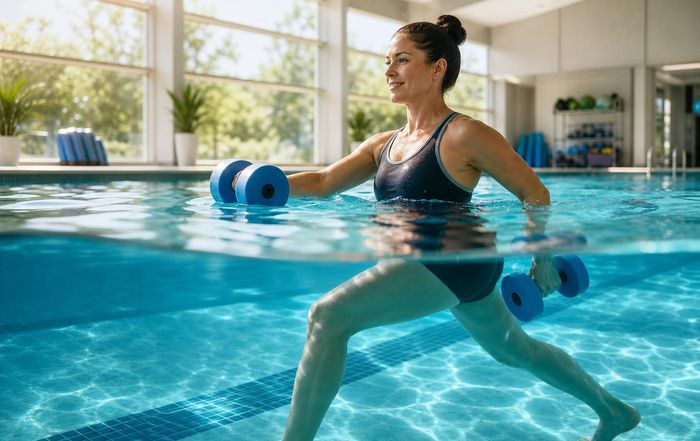
To increase challenge without increasing impact, you can use the water's resistance more deliberately. Pump your arms as if power-walking, or hold light foam dumbbells just below the surface and push them forward and back as you walk. You can also vary tempo: alternate 1-2 minutes of brisk walking with 1-2 minutes of slower, recovery-pace movement for a simple interval effect. Over several weeks, this can evolve into 20-30 minutes of continuous activity at a moderate intensity where you can still talk but not sing.
This style of workout aligns well with general physical activity recommendations from bodies such as Health Canada at https://www.canada.ca/ and the Australian Department of Health at https://www.health.gov.au/, which encourage at least 150 minutes of moderate aerobic activity per week for adults. For those restarting, three 20-minute shallow-water sessions per week can be a manageable stepping stone toward that goal, especially when combined with light walking on land. Readers interested in complementary land-based routines can explore the physical training section for additional ideas.
Deep-Water Running: Cardio Without the Pounding
Once comfort in the pool is established, deep-water running (also called aqua jogging) offers a way to achieve a surprisingly intense cardiovascular workout with virtually no impact. This makes it popular not only among people returning from injury but also among endurance athletes looking to maintain fitness while minimizing stress on bones and joints. Many sports medicine practitioners, including those referenced by organizations like World Athletics at https://worldathletics.org/, view deep-water running as a useful cross-training tool.
In deep-water running, you wear a buoyancy belt or use a flotation device so that your head stays comfortably above water while your feet do not touch the bottom. You then mimic a running or high-knee marching motion, driving the arms and legs through the water. The resistance forces you to work harder than on land at the same apparent speed, so it is wise to begin conservatively. A simple introductory structure might be: 5 minutes of easy deep-water marching, 5 minutes of slightly faster "jogging," and 5 minutes of alternating 30 seconds of stronger effort with 60-90 seconds of very easy movement.
Because it can be difficult to gauge intensity without pace or distance, using perceived exertion is practical. Aim for a level where breathing is deeper but conversation in short phrases is still possible. If you are returning from a running-related injury, this type of workout can help maintain aerobic conditioning while sparing the injured tissues from impact. However, it should complement, not replace, a gradual reintroduction of land running once cleared by a professional.
For those interested in broader sports performance implications, the sports section often explores how athletes integrate cross-training modalities like deep-water running into their programs. Recreational runners can adapt these principles at a smaller scale, using pool sessions on days when joints feel sore or when weather makes outdoor training unappealing.
Gentle Swimming Sessions: Technique Over Distance
Swimming itself can be an excellent way to return to exercise, but it is not automatically low-stress. Poor technique, breath-holding, or pushing too hard too soon can make even short swims feel overwhelming. For people who are not experienced swimmers, structured swimming lessons from a certified coach or instructor can dramatically improve efficiency and safety. Organizations such as Swim England at https://www.swimming.org/ and USA Swimming at https://www.usaswimming.org/ provide guidance on learn-to-swim programs and coaching standards.
When using swimming as a return-to-exercise tool, the emphasis should initially be on relaxed form and short repeats rather than long, continuous distances. For example, a beginner-friendly session might consist of 25-meter lengths of gentle backstroke or breaststroke with ample rest between each, totaling 10-15 minutes of actual swimming. As fitness improves, you can gradually reduce rest intervals or add a few more lengths, keeping the total session time within 20-30 minutes.
Choice of stroke matters. Many people find backstroke easier on the neck and shoulders than front crawl (freestyle), while breaststroke can be more comfortable for those who prefer keeping the head above water, though the frog-kick may aggravate some knee issues. If you have existing shoulder or neck problems, a physiotherapist or experienced coach can help you choose and adapt strokes to your situation. Using tools like kickboards or pull buoys can also let you emphasize either the legs or upper body without overloading both at once.
Breathing rhythm is a common limiting factor. Practicing exhaling steadily into the water and inhaling quickly when the mouth clears the surface can reduce anxiety and improve endurance. For readers who enjoy structured progression, thinking of swimming as skill practice rather than a pure fitness test can make the process more rewarding: each session is an opportunity to refine technique a little further rather than prove how far you can go. For complementary guidance on endurance and conditioning, the training section provides additional context that can be adapted to aquatic settings.
Aqua Aerobics and Group Classes: Social Structure and Motivation
Not everyone wants to design their own workout, and for many people returning to exercise, the social structure of a class can be a powerful motivator. Aqua aerobics, water fitness, and hydrotherapy classes are offered in many community pools and gyms, often at different intensity levels. Reputable organizations such as the YMCA at https://www.ymca.net/ and Les Mills at https://www.lesmills.com/ have developed standardized aquatic programs or partner with facilities that do, though specific offerings vary by location.
A typical beginner-friendly aqua class combines rhythmic movements like marching, kicks, arm sweeps, and gentle jumps performed to music, often using equipment such as foam dumbbells or noodles. The instructor can modify exercises for different abilities, which is particularly helpful if you are unsure how hard to push yourself. Because the group moves together, time can pass quickly, and many participants find it easier to maintain consistency when sessions are scheduled and social.
For those managing health conditions, specialized classes-such as arthritis aquatics or post-rehab water fitness-may be available through hospitals, physiotherapy clinics, or local health organizations. In some countries, national health services or insurance providers partially support such programs when prescribed. Checking with local healthcare providers or public health sites, such as NHS at https://www.nhs.uk/, can reveal options that are not widely advertised.
That said, group classes are not ideal for everyone. If you prefer to move at your own pace or feel self-conscious in groups, starting with individual sessions in quieter pool hours may be more comfortable. Over time, some people blend both approaches: solo practice for specific goals and periodic classes for variety and social connection. From a broader lifestyle perspective, building an enjoyable routine-whether solitary or social-is often more important than any particular exercise choice, a theme echoed repeatedly in lifestyle and wellness coverage.
Strength and Core Work in the Water: Building Support for Daily Life
While many people think of pool workouts as primarily cardio, water can also be used for gentle strength and core training, which is crucial when returning to exercise. Stronger muscles around the hips, knees, shoulders, and trunk help support joints and reduce the risk of future injury. Health authorities such as the U.S. Department of Health and Human Services at https://www.hhs.gov/ recommend at least two days per week of muscle-strengthening activities for adults, and water-based resistance work can count toward this guideline, especially in the early stages.
In chest-deep water, you can perform squats by sitting the hips back while keeping heels on the floor, using the water's buoyancy to reduce load and help with balance. Standing calf raises, side leg lifts, and gentle lunges can all be made more manageable by holding onto the pool edge or a rail. Because water resists movement in all directions, even slow leg lifts become meaningful work for the hips and core. For the upper body, pushing and pulling foam dumbbells under the surface or performing "push-ups" against the pool wall provide light resistance that can be increased by moving faster or using larger equipment.
Core engagement is almost unavoidable in water, but you can emphasize it with specific drills such as standing knee lifts with a slight forward lean, or "bicycle" movements while holding onto the pool edge and floating the legs. In deep water, treading water itself becomes a whole-body strength-endurance exercise, though it should be approached cautiously by less confident swimmers and always in a supervised environment.
As you progress, combining aquatic strength work with simple land-based exercises like bodyweight squats or wall push-ups can create a balanced program. Readers interested in more detailed resistance-training concepts can explore the fitness and physical training sections, adapting general principles-such as progressive overload and adequate recovery-to the aquatic setting. The key is gradual progression: slightly more repetitions, a bit more range of motion, or a marginally higher tempo, rather than abrupt jumps in difficulty.
How to Progress Over Weeks Without Overdoing It
One of the biggest risks when returning to exercise is enthusiasm outpacing tissue readiness. The pool reduces impact but does not eliminate the possibility of overuse, especially for shoulders, knees, and lower back. A structured, conservative progression plan can help you reap the benefits of aquatic exercise without sliding into the familiar cycle of "too much, too soon."
A practical approach for many people is to start with two pool sessions per week of 20-30 minutes each, including warm-up and cool-down, and then increase either duration or frequency by about 10-15 percent every week or two, depending on how the body responds. If you begin with 20 minutes twice a week, for example, you might move to 25 minutes twice a week, then 25 minutes three times a week, and so on, paying attention to signs of excessive fatigue, joint soreness that persists beyond 24-48 hours, or disrupted sleep. These progression concepts are consistent with broader return-to-activity guidance from sports medicine organizations and public-health bodies.
Variety also helps. Alternating between shallow-water walking, light swimming, and a simple aqua strength circuit can distribute load across different tissues and keep the routine mentally engaging. Over time, you can introduce small intervals of higher effort-for example, 1 minute of faster water jogging followed by 2-3 minutes of easy movement-while keeping the bulk of the session at a comfortable pace. This mirrors principles of interval training discussed frequently in training and sports coverage, scaled appropriately for those returning from inactivity.
It is also worth planning how pool workouts fit into your overall week. On non-pool days, gentle walking, stretching, or yoga can complement aquatic sessions without overloading the same structures. Nutrition and hydration play supporting roles: ensuring adequate protein and overall energy intake helps recovery, while drinking water before and after pool sessions is important even if you do not feel sweaty. For more on these topics, readers may find the nutrition section useful.
When the Pool Becomes a Long-Term Training Option
For some people, the pool is a temporary bridge back to land-based activities like running, cycling, or strength training. For others, especially those with chronic joint conditions or a strong affinity for water, aquatic exercise may become the primary long-term training environment. Both approaches are valid, and the right choice depends on individual goals, medical considerations, and personal preference.
If your aim is to transition back to land sports, the pool can be used strategically to build capacity while gradually reintroducing impact. For example, a runner might start with two pool sessions and one very short, easy land run per week, then slowly shift the ratio as tolerance improves. A person returning to gym-based strength work might continue using the pool on recovery days for low-impact cardio and mobility. In these cases, communication between healthcare providers, coaches, and the individual is helpful to coordinate progression and avoid conflicting loads.
On the other hand, aquatic exercise alone can support substantial health benefits, particularly when sessions are regular and varied. Combining moderate-intensity water workouts with attention to diet, sleep, and stress management can meaningfully improve cardiovascular fitness, blood-sugar control, and overall well-being-outcomes consistently highlighted in public-health guidance from organizations like the World Health Organization and national health agencies. For individuals with limitations that make high-impact or heavy resistance work impractical, the pool can be a primary training ground rather than a compromise.
However you choose to use it, the pool offers a uniquely adaptable environment for returning to exercise. Whether through quiet solo laps, structured aqua jogging, or energetic group classes, water allows people at many ability levels to move with less pain and more confidence. Thoughtful progression, attention to safety, and a willingness to adjust based on how your body feels will help ensure that your return to exercise is not just successful in the short term, but sustainable for the long run. That is where this particular wet journey ends. Another story, question, or perspective is always ready to begin.