

Inside Germany's Growing Outdoor Exercise Culture
Across German cities, suburbs, and small towns, a quiet shift is happening in how people move, train, and socialise. Jogging paths are busier, calisthenics parks are full after work, and "Trimm-dich" trails from the 1970s are being renovated rather than removed. Outdoor fitness in Germany is no longer a niche for hardcore runners or hikers; it is becoming a mainstream movement that cuts across ages, incomes, and training styles. Join us as we investigate what is driving Germany's outdoor exercise culture, how it differs from more traditional gym-based fitness, and what it means for anyone who wants to get fitter in a park rather than under fluorescent lights.
From "Trimm-Dich" to Today's Calisthenics Parks
Germany's outdoor exercise story did not start with Instagram-era street workouts. In the 1970s, the federal government launched the "Trimm Dich durch Sport" ("Get fit through sport") campaign, encouraging everyday citizens to move more. Municipalities built thousands of simple fitness stations along forest paths and park loops. These "Trimm-dich-Pfade" offered pull-up bars, balance beams, and basic strength and coordination tasks, often accompanied by cartoon mascots explaining the exercises.
Many of those original trails later fell into disrepair as indoor gyms boomed in the 1990s and 2000s. But instead of disappearing completely, the concept has been revived and modernised. Cities such as Berlin, Hamburg, and Munich have renovated or rebuilt outdoor courses with durable steel bars, rubberised flooring, and clear signage. The focus has shifted from state-driven mass campaigns to more community-led and city-level initiatives, but the underlying idea is similar: make movement accessible, free, and close to where people live.
This history helps explain why outdoor fitness feels culturally familiar in Germany. Unlike in some countries where public exercise equipment is a relatively new addition, German residents often remember using these trails as children. The nostalgia factor blends with contemporary fitness trends-calisthenics, functional training, and bodyweight workouts-creating a bridge between old and new. For readers interested in structured bodyweight programs that can translate well to parks and outdoor gyms, our training section often explores calisthenics and functional routines.
Urban Design, Green Spaces, and the German Relationship with Nature
One reason outdoor exercise has room to grow in Germany is physical: many cities are designed with green spaces, walking paths, and accessible public transport that makes parks easy to reach. According to the European Environment Agency at https://www.eea.europa.eu/, German cities such as Frankfurt and Hamburg rank high for urban green space per resident. This means runners, walkers, and cyclists can often find traffic-free routes within minutes of their front door.
Germany's long-standing culture of Wandern (hiking) and Spazierengehen (taking a walk) also sets a foundation. Walking in forests, along rivers, or through parks is not only a leisure activity but also a social ritual. The country's extensive network of marked hiking trails, maintained in part by organisations such as the Deutscher Wanderverband, gives weekend exercisers easy access to longer, more demanding routes without needing a car. The world and lifestyle sections frequently touch on how such cultural habits shape activity patterns in different regions.
Urban planners and health authorities increasingly see outdoor exercise infrastructure as part of preventive health strategy. The World Health Organization at https://www.who.int/ has repeatedly highlighted the role of green, walkable cities in combating sedentary lifestyles and chronic disease, and German municipalities have been receptive. New housing developments often include playgrounds that double as movement spaces for adults, multi-use sports courts, and running loops around artificial lakes or parks.
This built environment matters for behaviour. When a running path and a set of pull-up bars are directly outside a commuter's tram stop, the barrier to "doing something quick" on the way home shrinks dramatically. For time-pressed professionals or parents, this convenience can be the difference between staying inactive and maintaining a regular fitness habit.
Pandemic Shock: How COVID-19 Accelerated the Outdoor Shift
The COVID-19 pandemic acted as a powerful booster for outdoor exercise in Germany. When indoor gyms were repeatedly closed or heavily restricted, people turned to parks, riversides, and forest trails to stay active. According to the Robert Koch Institute at https://www.rki.de/, physical activity patterns shifted noticeably during lockdowns, with walking, running, and cycling becoming some of the most common forms of exercise.
This shift had several lasting effects. First, many people discovered that they actually enjoyed training outside more than expected-especially those who had previously associated fitness with crowded weight rooms. Second, communities of outdoor exercisers formed organically: neighbours met on running loops, informal bootcamps popped up in parks, and calisthenics enthusiasts shared equipment and skills. Third, municipalities saw visible evidence that their outdoor facilities were heavily used, strengthening the case for further investment.
At the same time, digital tools made outdoor training more structured. Apps from companies like Adidas at https://www.adidas.com/ and Nike at https://www.nike.com/ offered guided runs, interval sessions, and bodyweight workouts that could be done in any open space. German-language fitness influencers on platforms like YouTube and Instagram began programming park-based routines that required minimal equipment, further normalising outdoor sessions. For those interested in the intersection of digital tools and workouts, our technology coverage often explores how apps and wearables shape training habits.
Even after gyms reopened, many people kept at least part of their routine outdoors. For some, the park became their primary "gym"; for others, outdoor sessions now complement indoor strength work. In surveys across Europe, organisations such as Eurobarometer (via the European Commission at https://europa.eu/) have reported sustained increases in walking and cycling for both transport and leisure, and Germany fits that pattern.
What Outdoor Exercise Looks Like on the Ground
Germany's outdoor exercise culture is diverse, and it varies significantly between dense city districts, mid-sized towns, and rural regions. Yet several recurring patterns stand out.
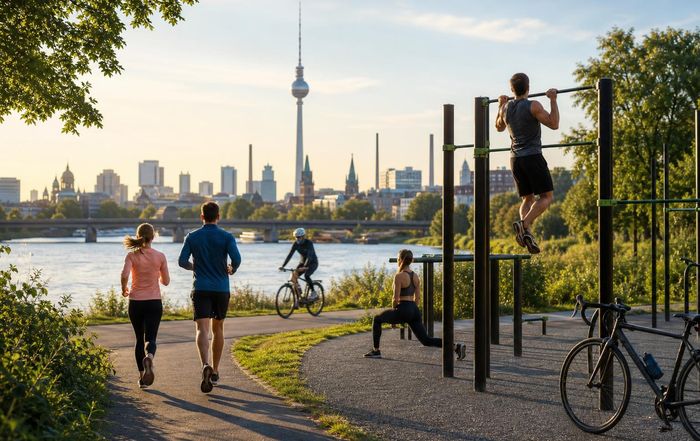
In major cities, early mornings and evenings often bring waves of runners to riverside paths such as Berlin's Spree, Munich's Isar, or Cologne's Rhine. Many combine steady runs with bodyweight stops at calisthenics parks-pull-ups, dips, planks, and step-ups on benches-creating hybrid cardio-strength sessions. On weekends, improvised bootcamps and group workouts are common, sometimes led by freelance trainers, sometimes organised informally via messaging groups.
Cycling is another major pillar. Germany has long been a strong market for everyday and recreational cycling, and the boom in e-bikes has expanded the age and fitness range of people who can comfortably tackle longer rides. Data from organisations like the Allgemeiner Deutscher Fahrrad-Club (ADFC) at https://www.adfc.de/ show steady growth in cycle tourism and commuting. For some, cycling doubles as both transportation and exercise, aligning with broader environmental and sustainability goals.
In smaller towns and rural areas, outdoor exercise often centres around football pitches, athletics tracks, and traditional sports clubs (Vereine). Yet even here, one can see more adults using school tracks after hours, families walking Nordic-style with poles, and older adults performing balance and mobility drills at public stations. Nordic walking, once stereotyped as "only for pensioners," has gained a broader following as people recognise its cardiovascular benefits and low joint impact.
For readers exploring different ways to train outside, our physical and wellness sections regularly look at how to balance intensity, recovery, and enjoyment in varied environments-from city parks to mountain trails.
Health, Performance, and Mental Wellbeing Benefits
Many of the benefits of outdoor exercise are not unique to Germany, but the country's climate, infrastructure, and health system shape how they play out locally. On the physical side, regular moderate-to-vigorous activity-whether in a gym or outdoors-reduces the risk of cardiovascular disease, type 2 diabetes, and several cancers. Guidelines from the World Health Organization recommend at least 150-300 minutes of moderate aerobic activity per week, combined with muscle-strengthening activities on two or more days. Outdoor formats like brisk walking, running, cycling, and park-based strength sessions fit these recommendations well.
Where outdoor exercise may offer additional advantages is mental health. Research summarised by institutions such as Charité - Universitätsmedizin Berlin at https://www.charite.de/ and the German Center for Neurodegenerative Diseases (DZNE) at https://www.dzne.de/ suggests that physical activity in green environments can reduce stress, improve mood, and support cognitive function more than equivalent indoor exercise for some people. Exposure to daylight also supports circadian rhythms, which in turn influence sleep quality, hormonal balance, and recovery from training.
Social factors matter too. Many outdoor workouts in Germany are inherently communal: running groups, sports clubs, or simply familiar faces on the same path each morning. That sense of belonging can make exercise more sustainable over time. For people who feel intimidated by the aesthetics or atmosphere of some commercial gyms, a park can feel more democratic and less judgmental.
However, outdoor exercise is not without challenges. Weather conditions, especially in winter, can deter participation. Air quality near busy roads can be a concern, and people with allergies may struggle during peak pollen seasons. Organisations like the German Environment Agency (Umweltbundesamt) at https://www.umweltbundesamt.de/ publish air-quality information that can help exercisers choose routes and times with lower pollution exposure. Balancing these factors-health benefits versus environmental conditions-is part of the decision-making process for regular outdoor athletes.
The Role of Sports Clubs, Municipalities, and the Fitness Industry
Germany's strong network of sports clubs (Sportvereine) plays a distinctive role in shaping outdoor exercise habits. These member-run organisations, often supported by municipalities and regional associations, offer structured training across sports such as athletics, football, rowing, triathlon, and outdoor fitness. The German Olympic Sports Confederation (DOSB) at https://www.dosb.de/ has highlighted the importance of clubs in delivering low-cost, community-based physical activity, including outdoor programs.
Municipalities are another key actor. Local governments decide whether to invest in running tracks, lighting for park paths, outdoor gyms, and safe cycling infrastructure. In many cities, health departments, planning offices, and sports authorities now collaborate more closely, recognising that active citizens can reduce long-term healthcare costs. Germany's statutory health insurers (Krankenkassen) sometimes reimburse participation in certified prevention courses, some of which are held outdoors, blending public health policy with on-the-ground training.
The commercial fitness industry has also adapted. While Germany remains one of Europe's largest markets for low-cost gyms, many operators now offer outdoor bootcamps, rooftop classes, or hybrid memberships that include both indoor and outdoor sessions. Personal trainers increasingly market "park training" as a flexible, lower-cost option, using minimal equipment such as resistance bands, suspension trainers, and portable kettlebells. For those interested in how businesses are responding, our business and brands pages often analyse how fitness companies reposition themselves around new habits.
This ecosystem-clubs, municipalities, insurers, and private providers-creates multiple entry points into outdoor exercise. A newcomer might join a free running group, take a subsidised back-care course in a park, or sign up for a commercial outdoor bootcamp. Over time, these options can reinforce each other, helping outdoor activity feel less like a temporary trend and more like a permanent feature of German fitness culture.
Barriers, Inequalities, and Safety Concerns
Despite visible growth, outdoor exercise in Germany is not equally accessible or comfortable for everyone. Socioeconomic factors, gender, age, and migration background all influence who uses public spaces for sport.
In some neighbourhoods, especially on the outskirts of large cities, public parks may be scarce or poorly maintained. Lighting can be insufficient, making early-morning or evening training feel unsafe. Women, in particular, often report concerns about harassment or lack of social safety when exercising alone in certain areas. These issues are not unique to Germany, but they shape participation patterns. Urban-policy debates increasingly include calls for "gender-sensitive" planning of parks and sports facilities, considering visibility, lighting, and escape routes.
Weather is another barrier. Germany's long, dark winters and frequent rain can discourage people who are not yet deeply committed to their routines. While experienced runners and cyclists often train year-round with appropriate clothing, beginners may struggle to maintain motivation. Indoor facilities still play an important role here, which is why a balanced health and fitness approach often mixes both environments.
There are also physical accessibility questions. Not all outdoor fitness equipment is usable for people with disabilities, and some parks lack smooth paths or adapted stations. Organisations representing disabled athletes, working with bodies like the German Paralympic Committee at https://www.dbs-npc.de/, advocate for more inclusive design-such as lower bars, ramps, tactile guidance paths, and clear signage.
Finally, there is the question of long-term maintenance. Outdoor gyms and trails are only attractive if they are clean, safe, and functional. Budget constraints can lead to delayed repairs or neglected spaces, which in turn reduces use and weakens the argument for future investment. Here, citizen initiatives-volunteer clean-up groups, neighbourhood associations, and local sports clubs-sometimes step in to support municipalities, illustrating how community engagement can sustain public exercise infrastructure.
How Germany Compares Internationally
Germany is not alone in embracing outdoor exercise, but its approach differs from that of other fitness-focused countries. In parts of Scandinavia, the concept of friluftsliv (open-air life) and widespread access rights to nature underpin a deeply ingrained outdoor culture. In the United States, outdoor fitness often revolves around national parks, trail running, and boutique bootcamps, with a stronger role for private providers. In East Asian cities, public parks sometimes feature large groups of older adults engaging in tai chi or dance-based exercise under the guidance of community leaders.
Germany's model sits somewhere in the middle: strong municipal responsibility for infrastructure, powerful sports clubs that organise participation, and a large but increasingly flexible commercial fitness sector. Data from the Organisation for Economic Co-operation and Development (OECD) at https://www.oecd.org/ suggest that while Germany still faces significant challenges with overweight and obesity, its rates of regular recreational physical activity are relatively high compared with several other industrialised nations.
What sets the German outdoor exercise culture apart is perhaps less a single unique feature and more the combination: historic "Trimm-dich" roots, a dense network of sports clubs, widespread urban green space, and a health system that recognises prevention as part of its mandate. For international observers, Germany offers an example of how public policy, civic tradition, and fitness trends can align to make everyday movement more visible and normalised.
Practical Takeaways for Training Outdoors in Germany
For anyone living in or visiting Germany who wants to tap into this outdoor movement, several practical points stand out. First, start local. Most cities and even mid-sized towns maintain online maps of parks, running loops, and outdoor gyms on their municipal websites. Health insurers and sports clubs often list certified courses, some of which take place in parks or on trails and may be partly reimbursed.
Second, think in terms of mixed sessions rather than single-purpose workouts. A typical 45- to 60-minute outdoor routine might combine brisk walking or easy jogging with short strength intervals at benches or bars: step-ups, push-ups, dips, rows, squats, and core work. Readers can find additional ideas for structuring such hybrid routines in our training and fitness coverage.
Third, plan for seasons. In winter, reflective clothing, headlamps, and layered outfits are essential, especially in northern regions with limited daylight. In summer, early mornings or late evenings can help avoid heat, and sunscreen is often necessary even on overcast days. Checking air-quality and pollen forecasts through services linked from organisations like the Umweltbundesamt or major weather portals such as Deutscher Wetterdienst at https://www.dwd.de/ can help you choose suitable times and locations.
Finally, consider the social side. Joining a local running group, outdoor yoga class, or calisthenics community can make sessions more enjoyable and sustainable. Many groups are beginner-friendly and communicate through social media, club websites, or noticeboards at sports facilities. For those who prefer to train solo, simply sharing space with others can still provide a sense of motivation and safety.
Where Germany's Outdoor Exercise Culture May Be Heading
Browsing ahead, several trends suggest that Germany's outdoor exercise culture will continue to grow and evolve rather than fade as a post-pandemic phenomenon. Climate and environmental concerns are likely to push more people toward active transport-walking and cycling-as everyday exercise. Digital tools will keep blurring the line between individual and group training, as runners follow live-coached sessions via headphones or join virtual challenges while physically moving through local parks.
Policy debates about urban planning, public health, and social cohesion will also shape the landscape. Investments in safe cycling lanes, well-lit parks, and inclusive outdoor gyms are not just infrastructure decisions; they are choices about what kind of movement culture cities want to foster. As Germany grapples with demographic change and rising healthcare costs, encouraging older adults to stay active outdoors could become a central strategy for maintaining quality of life and controlling expenditure.
For individuals, the message is relatively simple but powerful: high-quality fitness does not require a membership card or complex machines. With a pair of shoes, some weather-appropriate clothing, and access to a park, river path, or forest trail, it is possible to build strength, endurance, and resilience in ways that connect body, mind, and environment. Germany's growing outdoor exercise culture shows how public spaces can become everyday training grounds-and how movement can feel less like an isolated workout and more like a natural part of daily life.