

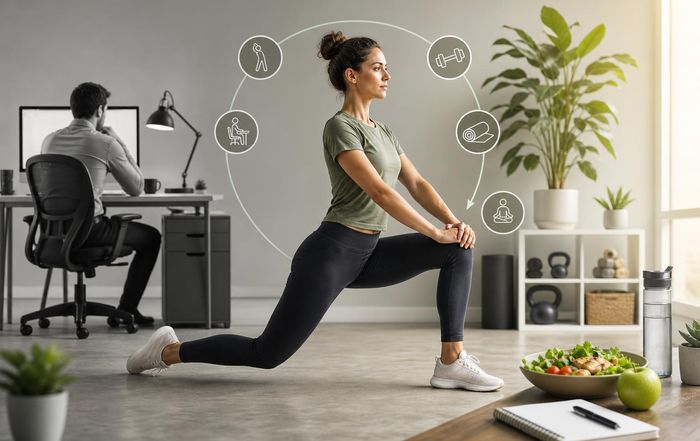
A Guide to Functional Fitness for Desk Workers
Long hours at a desk change how the body moves. Hips tighten, shoulders round forward, necks crane toward screens, and core muscles switch off. Over time, this can make everyday tasks-carrying groceries, climbing stairs, even getting up from a chair-feel harder than they should. Functional fitness is a way to reverse that drift, using movements that prepare the body for real life rather than just the gym. This guide looks at what functional fitness means for desk workers specifically, how sitting all day reshapes the body, and how to build a simple, sustainable routine that fits around a busy schedule. It focuses on movements you can do with minimal equipment, at home, in the office, or alongside a more structured training plan.
What "functional fitness" really means when you sit all day
Functional fitness often gets marketed as a buzzword, but for desk workers it has a very practical definition: training patterns of movement that you actually use in daily life, under the constraints of a sedentary job. That means less emphasis on isolated muscles and more on integrated actions like squatting, hinging at the hips, pushing, pulling, rotating, and carrying loads while maintaining posture and balance.
Organizations such as the American College of Sports Medicine and World Health Organization emphasize that adults should aim for regular aerobic activity plus muscle-strengthening work that involves major muscle groups at least twice a week. Functional fitness folds those recommendations into natural patterns: learning to hinge properly protects the lower back when lifting, strengthening the upper back and core counters the rounded posture of desk work, and training single-leg balance reduces the risk of falls and ankle or knee tweaks in everyday life. For office-based workers, it also means choosing exercises that undo the specific imbalances created by prolonged sitting: tight hip flexors, weak glutes, stiff thoracic spine, and overworked neck and shoulder muscles.
Functional training does not require advanced equipment or a gym membership. Many effective exercises use only body weight, resistance bands, or a single dumbbell or kettlebell. What makes them "functional" is that they train control through full ranges of motion, under load, while keeping joints aligned. That quality of movement is far more important than how heavy the weight is or how impressive the exercise looks on social media.
How desk work changes your body (and why it matters)
A growing body of research from groups such as the World Health Organization (WHO), Centers for Disease Control and Prevention (CDC), and Public Health England highlights the health risks of prolonged sedentary time: increased risk of cardiovascular disease, type 2 diabetes, weight gain, and certain cancers, even in people who meet exercise guidelines. For functional fitness, the more immediate issue is how sitting alters movement quality.
When you sit for hours, the hip flexors remain shortened while the gluteal muscles are largely inactive. Over time, this contributes to "anterior pelvic tilt," where the pelvis tips forward, increasing the curve of the lower spine and placing extra stress on the lumbar region. The upper body is affected too: shoulders roll forward, the upper back rounds, and the head shifts in front of the body, forcing the neck muscles to work harder to hold it up. This "forward head posture" is strongly associated with neck pain, tension headaches, and shoulder impingement.
At the same time, your core muscles-particularly the deep stabilizers that support the spine-do not get much challenge from static sitting. That can make it harder to maintain a neutral spine when lifting, twisting, or carrying loads, whether in the gym or just moving furniture at home. Over months and years, the combination of weak stabilizers, tight hips, and rounded shoulders sets the stage for back pain, reduced mobility, and a higher risk of injury during occasional bursts of activity, such as weekend sports or intense physical challenges.
Functional fitness for desk workers therefore has a dual goal: reduce the health impact of prolonged sitting by breaking it up and increasing general activity, and specifically retrain the body to move well in key patterns that sitting disrupts.
The movement patterns desk workers should prioritize
Instead of thinking in terms of "leg day" or "arm day," functional fitness focuses on patterns. For people who spend much of the day at a computer, five categories are especially important.
The hip hinge is the foundation of safe bending and lifting. Movements like deadlifts and good mornings teach you to fold at the hips while keeping the spine neutral, loading the glutes and hamstrings rather than the lower back. This is vital for tasks like picking up boxes or lifting a child from the floor. Many desk workers lose this pattern, substituting a rounded-back bend that stresses spinal discs.
The squat pattern underpins getting in and out of chairs, climbing stairs, and many sports movements. Functional squatting involves the hips and knees bending together, weight distributed through the mid-foot and heel, and the torso staying as upright as mobility allows. Office workers often develop ankle stiffness and hip tightness that make deep, comfortable squatting difficult, so restoring range of motion is a priority.
Upper-body push and pull patterns are crucial for shoulder health. Pushing includes horizontal pushes like push-ups and vertical pushes like overhead presses; pulling covers rows, pull-ups, and band pull-aparts. Because desk work encourages a rounded, internally rotated shoulder position, strengthening the upper back and external rotators through pulling movements is especially important to balance out any pressing.
Core stability and anti-rotation work is another pillar. Rather than endless sit-ups, functional core training emphasizes resisting unwanted movement-maintaining a neutral spine while the limbs move, or resisting twist and side-bend forces. Planks, dead bugs, bird-dogs, and loaded carries train this kind of stability, which is more directly relevant to daily tasks such as carrying bags or stabilizing the torso while turning.
Finally, single-leg balance and gait patterns support walking, running, and stair climbing. Desk jobs can reduce proprioception (the body's sense of position) and ankle stability simply because people spend less time on one leg or moving over varied terrain. Single-leg deadlifts, step-ups, and balance drills help restore that capacity, reducing the likelihood of falls and lower-limb injuries.
Building a functional routine around a desk job
For many office-based professionals, the main barrier is not knowledge but time and consistency. The evidence from organizations such as the American Heart Association (AHA) and National Health Service (NHS) is clear: the best program is the one you can sustain. A realistic starting point is two to three structured strength sessions per week, plus frequent movement breaks during the workday.
A typical 30-40 minute session might include a warm-up, four to six compound exercises covering the key patterns, and a short finisher or mobility block. For example, a session could pair a hip hinge with a horizontal push (such as a deadlift variation and push-up), then a squat with a horizontal pull (goblet squat and dumbbell row), plus core stability work like planks or dead bugs. Another day might emphasize single-leg work (step-ups, split squats), vertical pulling or rowing with bands, and overhead pressing with light dumbbells or kettlebells.
Breaking long sitting periods is just as important as the workouts themselves. The CDC and other public health bodies encourage standing or walking breaks every 30-60 minutes. That does not have to mean a full workout; two minutes of walking, a set of desk-friendly mobility drills, or a few bodyweight squats can restore blood flow and reduce stiffness. Over the course of a day, these micro-breaks add up and support the gains made in structured training.
To connect this with broader lifestyle habits, readers may find it useful to explore more general fitness coverage or wellness content that addresses sleep, stress, and recovery. Functional fitness is more effective when paired with adequate rest and a sustainable workload.
Desk-friendly mobility and strength "snacks"
Not every functional exercise requires a gym space. Many can be adapted to a small office or home workspace without drawing too much attention. Think of these as "movement snacks" sprinkled through the day rather than a full training meal.
For the upper body, wall slides and band pull-aparts help counteract rounded shoulders. Standing with your back against a wall, sliding your arms up and down in a "goalpost" shape promotes thoracic extension and shoulder mobility. Light resistance bands can be used for pull-aparts and face pulls to strengthen the muscles between the shoulder blades. Simple chin tucks, where you gently retract the head to align ears over shoulders, can reduce forward-head strain.
For the hips and legs, sit-to-stand squats from your chair are a straightforward way to train the squat pattern. Standing hip flexor stretches-stepping one foot back and gently tilting the pelvis posteriorly-help lengthen muscles that tighten from sitting. Calf raises and ankle circles can be done while holding the back of a chair, improving circulation and ankle mobility. Even brief walking laps around the office or up and down a flight of stairs contribute to overall physical activity.
The core can be engaged with subtle exercises such as seated pelvic tilts, where you alternate gently between arching and flattening the lower back while sitting tall, or by practicing "bracing," tightening the abdominal muscles as if preparing to be lightly poked. While these do not replace more robust core training, they help reinforce awareness of neutral spine and postural control throughout the day.
Resources from bodies like the Mayo Clinic (https://www.mayoclinic.org/) and Harvard T.H. Chan School of Public Health (https://www.hsph.harvard.edu/) provide additional simple movement ideas that can be integrated into a desk routine, many of which require no equipment.
A sample 3-day functional plan for office workers
To make the concepts more concrete, here is a sample weekly structure that balances strength, mobility, and practicality. It assumes minimal equipment (bodyweight, a pair of dumbbells or a kettlebell, and possibly a resistance band). Volume and difficulty can be adjusted to match experience.
Day 1 - Lower body and core focus
Begin with 5-7 minutes of dynamic warm-up: marching in place, hip circles, arm swings, and light bodyweight squats. Then move into a hip-hinge exercise such as Romanian deadlifts (with dumbbells or kettlebell) paired with a core stability move like the dead bug. Follow with goblet squats for the squat pattern and a side plank variation to challenge lateral core stability. Finish with a few minutes of hip flexor stretching and hamstring mobility work.
Day 2 - Upper body and posture
After a similar warm-up, start with push-ups (elevated on a desk or bench if needed) paired with a row variation (dumbbell rows or band rows). Add overhead presses with light weights if shoulder mobility allows, and balance them with band pull-aparts or reverse flyes to strengthen the upper back. Include a prone "Y-T-W" sequence on the floor or bench to activate the mid-scapular muscles that help counter desk posture. End with chest and thoracic spine stretches, such as lying over a rolled towel to open the upper back.
Day 3 - Single-leg, balance, and carries
This day focuses on unilateral work and integrated control. After warming up, perform step-ups onto a stable box or stair, followed by split squats or lunges. Include single-leg Romanian deadlifts (bodyweight or light weights) to challenge balance and hip stability. Finish with loaded carries if you have space-holding a weight in one or both hands and walking with tall posture. Farmer's carries (weights in both hands) and suitcase carries (weight in one hand) are particularly effective for building grip strength and core stability in a way that directly translates to everyday tasks like carrying bags or luggage.
Between these sessions, aim for frequent shorter bouts of movement during the workday and at least one longer bout of low- to moderate-intensity cardio, such as brisk walking, cycling, or swimming. Readers interested in more sport-specific conditioning might also explore sports coverage, which often highlights how athletes integrate functional patterns into their routines.
Adapting functional training to different bodies and abilities
Not every desk worker has the same needs or starting point. Some may be returning from injury, living with chronic conditions, or managing age-related changes in strength and mobility. Organizations such as the American Council on Exercise (ACE) and National Institute on Aging (NIA) emphasize tailoring exercise intensity and complexity to the individual, particularly for older adults or those with cardiovascular or musculoskeletal issues.
For people with back pain, for instance, exercises that load the spine heavily may need to be modified or replaced with supported variations. Hip hinges might start as simple "bowing" movements with hands on a desk, focusing on patterning rather than resistance. Those with knee pain may find box squats to a higher surface or supported split squats more tolerable than deep bodyweight squats. Shoulder issues might require starting with isometric holds or lighter band work before progressing to overhead pressing.
It is often worth consulting a qualified physiotherapist or certified trainer, especially if pain is present or if there is a history of injury. Professional guidance can help refine technique, choose appropriate progressions, and integrate medical advice. Many health systems and sports medicine clinics, such as those affiliated with Cleveland Clinic (https://my.clevelandclinic.org/) or Hospital for Special Surgery (https://www.hss.edu/), provide educational resources on safe exercise modifications that can complement in-person care.
Even without one-to-one coaching, the core principle remains: start with movements you can perform with control and without pain, then gradually increase load, range of motion, or complexity. Functional training should feel challenging but not threatening; joint discomfort, sharp pain, or lingering soreness beyond 48 hours are signals to adjust.
Supporting functional fitness with lifestyle habits
Movement quality improves faster when it is backed by supportive habits in nutrition, sleep, and stress management. Adequate protein intake, for example, is associated with better muscle maintenance and recovery, particularly in midlife and older adults, as highlighted by research summarized by the Academy of Nutrition and Dietetics (https://www.eatright.org/). Hydration also matters: even mild dehydration can impair cognitive function and perceived exertion, making workouts feel harder and recovery slower.
Sleep is another critical variable. Organizations such as the Sleep Foundation (https://www.thensf.org/) and American Academy of Sleep Medicine (https://aasm.org/) recommend 7-9 hours of quality sleep for most adults. Chronic sleep debt can undermine strength gains, increase injury risk, and make it harder to maintain consistent exercise habits, especially when combined with high work stress.
Stress itself influences posture and movement. High sympathetic arousal (the "fight or flight" response) often manifests as elevated shoulders, shallow breathing, and tension in the neck and jaw-all common complaints among desk workers. Incorporating brief breathing exercises, mindfulness practices, or simple relaxation techniques into the workday can reduce muscle tension and improve body awareness. Readers interested in broader lifestyle approaches may find related content under lifestyle or health, where topics such as stress management and work-life balance intersect with physical training.
Finally, the work environment itself can be adjusted. While no chair or desk setup can fully "fix" posture, ergonomic improvements-such as adjusting monitor height to eye level, ensuring feet rest flat on the floor, and using a chair that supports the lower back-can reduce strain and make it easier to maintain a neutral position between movement breaks. Guidance from official ergonomics resources, including those hosted by national occupational safety agencies or large health systems, can be a helpful complement to functional training.
Making functional fitness a sustainable part of work life
The most effective functional program for desk workers is not the most complex one, but the one that becomes as routine as checking email. That usually means starting smaller than instinct suggests: two or three 30-minute sessions per week, with frequent two-minute movement breaks during the day, is enough to noticeably improve stiffness, posture, and everyday strength within a few months. Consistency matters more than intensity.
Tracking simple metrics-such as how many comfortable sit-to-stand repetitions you can perform, how long you can hold a solid plank, or how easily you can carry groceries up stairs-provides feedback that is more relevant than scale weight or mirror changes alone. Many readers also find that improving movement capacity boosts confidence to try new activities, whether that is recreational sport, hiking, or more structured training programs.
For desk workers, functional fitness is less about chasing performance records and more about reclaiming natural movement that modern work erodes. By focusing on key patterns, integrating short bouts of movement into the workday, and supporting training with sound lifestyle habits, it is possible to turn a sedentary job into a base for long-term health rather than a barrier to it. So you should be motivated now. Make sure you leave your desk or screen for awhile and get out into open air, which is hopefully fresh and invigorating, bookmark, subscribe, share, see you back here tomorrow!