

Meal Planning for Fitness on a Tight Grocery Budget
Building a stronger, healthier body does not require expensive "superfoods," designer supplements, or daily takeout from health-focused cafés. For most people, the biggest levers for fitness progress are consistent training, enough protein, and mostly whole foods-and all of those can be organized around a modest grocery budget with a bit of planning. Meal planning is the bridge between your fitness goals and your bank balance: it helps you control portions, avoid waste, and hit your macros without constant impulse buys. This article looks at how to design a weekly eating strategy that supports strength, endurance, or fat loss while keeping costs under control, and how to adapt it across different countries and food cultures.
Start with your actual fitness goal and calorie needs
Before choosing foods, it helps to know what you're eating for. A strength athlete trying to gain muscle, a runner training for a half marathon, and someone focused on fat loss will all have different calorie and macronutrient needs, even if they shop in the same discount supermarket. Broadly, fitness-oriented meal planning usually aims for one of three directions: a small calorie surplus to build muscle, a moderate deficit to lose fat, or maintenance with an emphasis on performance and recovery. Estimating calorie needs does not have to be perfect, but a ballpark figure provides structure and prevents over- or undereating even when you're buying the cheapest staples. Reputable tools from organizations such as the U.S. National Institutes of Health (NIH) or physical activity guidance from the World Health Organization (WHO) can help you understand how body size, age, and activity level shape energy requirements, and many national health agencies offer similar calculators or tables on their websites.
Once you have a rough daily calorie target, you can decide how much of that should come from protein, carbohydrates, and fats. For most active people, sports nutrition research summarized by groups like the American College of Sports Medicine (ACSM) and the International Society of Sports Nutrition (ISSN) suggests about 1.4-2.0 grams of protein per kilogram of body weight to support muscle repair and growth, with the rest of calories split between carbohydrates and fats according to training volume and personal preference. You don't need to track every gram forever, but having a weekly plan that includes a protein source at each meal, a starchy base around harder workouts, and some healthy fats daily will keep you much closer to optimal than simply grabbing whatever is on discount with no structure. Readers who want to dig deeper into training-specific nutrition can also explore practical guides on our nutrition and training pages.
Build a budget-friendly "core foods" list
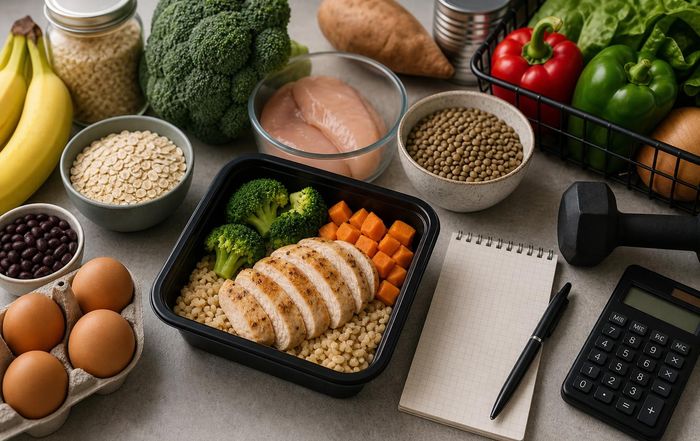
Once goals are clear, the next step is choosing a small set of inexpensive, versatile ingredients that can be reused across multiple meals. This "core foods" list is the backbone of budget meal planning: it minimizes waste, simplifies shopping, and ensures you always have building blocks for a balanced plate. Across many countries, the cheapest proteins tend to be eggs, dried or canned beans and lentils, frozen chicken thighs or drumsticks, canned fish such as sardines or mackerel, and, where culturally common, bulk tofu or tempeh. These foods are often significantly cheaper per gram of protein than lean steaks, boneless skinless chicken breasts, or heavily marketed protein snacks, and they store well, which reduces the risk of throwing away spoiled meat. Major public-health bodies such as NHS in the UK (NHS) and Health Canada (Canada.ca) routinely highlight beans, lentils, and eggs as affordable protein options that fit into national dietary guidelines.
For carbohydrates, the most budget-friendly choices are usually bulk bags of oats, rice, pasta, potatoes, and local seasonal grains or tubers. Buying generic or store-brand versions is often much cheaper than branded products, with no meaningful difference for fitness outcomes. Whole grains may cost slightly more per kilogram than refined ones in some markets, but they provide more fiber, which supports fullness and digestive health-useful if you're in a calorie deficit. On the fruit and vegetable side, frozen mixed vegetables, seasonal produce, and supermarket "imperfect" or "wonky" lines can drastically cut costs while preserving nutrient density. The Food and Agriculture Organization of the United Nations (FAO) notes that frozen vegetables can retain vitamins and minerals as well as, or sometimes better than, fresh produce that has spent a long time in storage or transport, making them a smart option when both price and nutrition matter.
Fats are often overlooked in budget planning because oils, nuts, and seeds can appear expensive, but small quantities go a long way. A litre of basic vegetable or canola oil may be more cost-effective for cooking than small bottles of premium olive oil, although where olive oil is locally produced it can be competitive. Bulk peanut butter, tahini, and sunflower seeds are relatively cheap ways to add calories and healthy fats, especially for people with high energy needs such as endurance athletes. Creating a written or digital list of 10-15 such staples that you consistently buy-protein, carb, fat, and vegetable sources-helps you avoid impulse purchases and keeps your nutrition aligned with your fitness goals even when prices fluctuate.
Design a simple weekly meal framework instead of rigid menus
A common mistake in meal planning is trying to script every meal for seven days in advance, which can be overwhelming, inflexible, and difficult to stick to when life changes. A more sustainable approach, especially on a tight budget, is to create a flexible weekly framework: a small number of breakfast, lunch, and dinner "templates" that you rotate and adapt based on what is on sale or what you already have at home. For example, breakfast might always be "oats + protein + fruit," which could mean oats with milk and banana one day and oats with yogurt and frozen berries another, depending on discounts and local availability. Lunch could follow a "grain + beans or lentils + vegetables + sauce" template, while dinners might be "protein + carb + vegetables," with the specific ingredients changing week to week.
This framework lets you plan your shopping list around components rather than exact recipes. If your dinner template calls for "protein + carb + vegetables," you can choose chicken thighs when poultry is discounted, switch to canned chickpeas or tofu when legumes are cheaper, or use canned fish when fresh meat prices spike. The same applies to carbohydrates: rice, pasta, couscous, or potatoes can all fill the same slot, allowing you to buy whatever is most affordable in your region. This approach mirrors the way many traditional food cultures have long eaten-variations on a few basic patterns-rather than the recipe-of-the-day model that can drive constant new purchases. It also makes it easier to meet macronutrient targets: you know that each meal includes a protein source, a carbohydrate base, and at least one serving of vegetables, which aligns with general guidance from organizations such as the Academy of Nutrition and Dietetics (eatright.org).
For busy people balancing training with work or family, this template method pairs well with batch cooking. Setting aside one or two blocks of time per week to cook a large pot of grains, a big tray of roasted vegetables, and a batch of protein (such as baked chicken, lentil stew, or tofu stir-fry) can provide mix-and-match components for several days. This not only saves money by reducing food waste but also supports consistent eating patterns that complement regular exercise. Readers interested in integrating meal prep with structured workouts can explore additional ideas in our training and wellness coverage, where we examine how routines influence adherence and long-term results.
Shop strategically: unit prices, store brands, and timing
Even a well-designed meal plan can become expensive if you shop without paying attention to how prices are presented. One of the most powerful habits for budget-conscious athletes is focusing on unit price-cost per kilogram, per 100 grams, or per litre-rather than the sticker price of the package. Supermarkets in many countries are required or encouraged by consumer-protection agencies such as the U.S. Federal Trade Commission (FTC) or the European Commission's consumer protection bodies (europa.eu) to display unit prices on shelf labels, making it easier to compare large and small packages or branded and generic products. Often, slightly larger bags of oats, rice, or frozen vegetables have a significantly lower unit price, and these staples store well if you have the space.
Store-brand or "private label" foods are another key tool for keeping costs down without compromising fitness outcomes. In many markets, generic canned beans, oats, and frozen vegetables are produced in the same facilities as more expensive branded items, with similar or identical nutrition profiles. For athletes, what matters most is the macronutrient content and ingredient list, not the branding. Checking labels to avoid added sugars or excessive sodium in canned goods is still important, but choosing store brands for basic items can free up money for higher-quality protein or fresh produce where it matters more. Public-health organizations such as Harvard T.H. Chan School of Public Health (hsph.harvard.edu) often emphasize label literacy as a way to improve diet quality without necessarily spending more.
Timing and shopping patterns also affect your budget. Some supermarkets discount fresh meat, bread, or produce near the end of the day or just before closing, especially on weekends. Buying these items and freezing what you won't use immediately can significantly reduce costs while still providing high-protein options for your physical training days. Local markets may offer better prices on seasonal produce close to closing time, when sellers prefer to clear stock rather than take it home. Planning your training week alongside your shopping trips-perhaps doing heavy batch cooking on the same day you buy fresh discounts-helps you align cost, freshness, and performance.
Prioritize protein without overspending
Protein is often the most expensive part of a fitness-focused diet, but it does not have to dominate your budget if you use a mix of animal and plant sources and think in terms of cost per gram of protein rather than cost per serving. In many countries, dried lentils, chickpeas, and split peas are among the cheapest protein sources when measured per gram of protein, and they also provide carbohydrates and fiber, which support fullness and gut health. Combining these with small amounts of higher-cost animal protein-such as adding a modest quantity of ground meat to a large pot of lentil stew-can create satisfying meals that support muscle maintenance at a fraction of the cost of meat-heavy dishes. Research summarized by organizations like Dietitians of Canada (dietitians.ca) indicates that mixed plant-animal protein patterns can adequately support active lifestyles when total protein intake is sufficient.
Eggs remain a staple in many budget-friendly fitness plans because they provide high-quality protein, healthy fats, and several vitamins and minerals at a relatively low price in most regions. Hard-boiled eggs can be prepared in bulk and used as snacks or salad toppings, while omelettes and frittatas are flexible vehicles for leftover vegetables. Canned fish such as sardines, mackerel, and tuna (where sustainably sourced and affordable) offer protein plus omega-3 fats, which are associated with heart health and potentially reduced exercise-induced inflammation according to bodies such as the American Heart Association (heart.org). For those who avoid animal products, tofu, tempeh, and textured vegetable protein can often be bought in bulk or at Asian supermarkets at lower prices than in mainstream grocery chains.
Protein powders can be cost-effective but are not mandatory. When comparing options, look at cost per 20-25 grams of protein, not the price of the tub. In some markets, basic whey or soy protein from large, reputable manufacturers is cheaper per gram of protein than many whole-food sources, but in others it is a luxury. If you choose to include powders, they are best used to fill gaps-such as a quick shake after a workout when you can't access a full meal-rather than replacing whole-food protein at every opportunity. Regardless of whether you use supplements, focusing your grocery budget on a few affordable, versatile protein staples and building meals around them is one of the most effective ways to support fitness progress without overspending.
Use carbs and fats intelligently to match training and appetite
For active people, carbohydrates are not the enemy of body composition; they are often the primary fuel for high-intensity training. The challenge on a tight budget is to choose carbohydrate sources that are both affordable and aligned with your goals. Bulk grains like rice, oats, and pasta, as well as potatoes, yams, or cassava where commonly eaten, are usually far cheaper per calorie than processed snacks, breakfast cereals, or energy bars, yet they provide a stable base for pre- and post-workout meals. Sports nutrition guidance from bodies such as Sport England (sportengland.org) and various national Olympic committees often highlights simple meals-rice with beans, pasta with tomato sauce and vegetables, or potato-based dishes-as adequate fuel for most amateur training, provided portion sizes are adjusted to workload.
Matching carbohydrate intake to training intensity is a powerful way to control both performance and budget. On days with hard strength or interval sessions, you might allocate more of your daily calories to carbohydrates, placing them around your workouts to support energy and recovery. On rest days or light-activity days, you can shift the plate balance slightly toward vegetables, protein, and fats while keeping carbs present but less dominant. This flexible approach allows you to buy the same cheap staples in bulk and simply vary portion sizes rather than constantly redesigning your grocery list. It also reduces reliance on expensive sports drinks and gels; for most recreational athletes, water plus regular meals are sufficient, as noted by organizations like USA Triathlon (usatriathlon.org).
Fats, meanwhile, help with hormone production, nutrient absorption, and satiety. When money is tight, it can be tempting to cut them too aggressively, but very low-fat diets are hard to sustain and may not support optimal training. Instead, aim for modest but consistent sources: a spoonful of oil for cooking, a small handful of nuts, or a spread of peanut butter on toast. These additions are calorie-dense, so they are particularly useful for people with high energy needs who struggle to eat large volumes of food. For those attempting fat loss, the same foods should be used more sparingly, but they do not need to be eliminated. Balancing carbohydrates and fats according to training demands, personal tolerance, and cultural food preferences allows you to stay within your budget while still aligning with your health objectives.
Minimize waste and repurpose leftovers creatively
Food waste is essentially money in the bin, and it is one of the most overlooked drains on a tight grocery budget. Effective meal planning for fitness is not only about what you buy but also about how completely you use it. Batch cooking lends itself naturally to repurposing: a large pot of chili made with beans and ground meat can be eaten with rice one day, stuffed into wholegrain wraps another, and served over baked potatoes later in the week. Roasted vegetables can reappear in omelettes, grain bowls, or blended into soups. Planning two or three different ways to use the same base dish when you cook it helps avoid the boredom that often leads to ordering takeaway.
Understanding basic food storage also extends the life of your ingredients. Many national food-safety agencies, such as the U.S. Department of Agriculture (usda.gov) and equivalents in Europe and Asia, provide guidance on how long cooked foods can safely be stored in the fridge or freezer. Following this advice reduces the risk of throwing away food for safety reasons and helps you feel confident about eating leftovers several days later. Freezing single portions of cooked meals is particularly powerful for fitness-focused individuals: it creates a stock of ready-to-heat options for busy days when willpower is low, reducing the temptation to buy more expensive convenience foods that may not align with your nutrition targets.
Creativity with "scraps" can also stretch your budget. Vegetable trimmings can be collected in a freezer bag and later simmered into broth for soups or stews. Slightly stale bread can become croutons or breadcrumbs. Overripe bananas are ideal for oatmeal, smoothies, or simple baked goods that can double as pre-workout snacks. This approach mirrors the resourcefulness of traditional cuisines worldwide, where necessity drove people to find uses for every part of an ingredient. For athletes and regular gym-goers, it also ensures that there is almost always something in the house that can be turned into a reasonably balanced meal, supporting the consistency that underpins long-term wellness.
Adjust for different regions, cultures, and dietary patterns
Budget-friendly fitness meal planning looks different in Bangkok than in Berlin, and different again in rural Brazil or urban South Africa. The principles-prioritize affordable protein, buy staple carbs in bulk, use seasonal or frozen vegetables, reduce waste-are widely applicable, but the specific foods and prices vary. In some Asian countries, tofu, tempeh, and eggs may be cheaper and more accessible than dairy products, while fish and rice are central staples. In parts of Latin America, beans, corn, and local tubers are inexpensive and culturally familiar foundations for high-energy diets. Across much of Europe, lentils, oats, and root vegetables are affordable, and discount chains often run rotating offers on frozen fish and poultry. Tapping into local staples rather than trying to copy meal plans from other regions is both cheaper and more sustainable.
Traditional dishes can often be slightly modified to better support specific fitness goals without losing their character. A classic rice-and-beans plate can become more protein-focused by increasing the bean portion and adding an egg or a small amount of meat; a noodle dish can gain more vegetables and lean protein while slightly reducing oil; a curry can be served with a smaller portion of rice and more lentils or chickpeas when fat loss is the priority. Public-health guidelines from regional organizations-such as the World Health Organization's regional offices (who.int) or national ministries of health-often highlight culturally appropriate dietary patterns that can be adapted for active lifestyles without requiring imported "health foods."
Dietary preferences and restrictions also shape budget planning. Vegetarians and vegans typically rely more heavily on legumes, soy products, nuts, and seeds, which can be extremely cost-effective when bought dried or in bulk. Omnivores have the option to incorporate small amounts of meat, poultry, and dairy, but do not need to base every meal around them. People with medical conditions such as celiac disease or food allergies may face higher costs for specialty products; in these cases, focusing on naturally gluten-free or allergen-free staples like rice, potatoes, beans, and certain whole foods can reduce reliance on expensive processed substitutes. Whatever the pattern, the key is to identify the cheapest nutrient-dense foods that fit your context and build your meal templates around them, rather than chasing an idealized "fitness diet" seen on social media.
When to spend a little more-and when not to
On a tight budget, it is important to distinguish between upgrades that meaningfully improve health or performance and those that are mainly about branding or convenience. Paying slightly more for items that reduce your risk of foodborne illness, such as safe meat and dairy from regulated sources, is usually worthwhile. Similarly, if you have the flexibility, investing in a modest supply of herbs, spices, and flavorings like garlic, onion, and chili can dramatically improve the taste of simple dishes, making it easier to stick to your plan instead of turning to takeaway. Over time, these small additions may save money by keeping you satisfied with home-cooked meals. Public-health and food-safety agencies worldwide, including the European Food Safety Authority (efsa.europa.eu), emphasize the importance of safe handling and storage, which sometimes means choosing slightly more expensive but better-regulated products in regions where informal markets carry higher risks.
By contrast, many heavily marketed "fitness" products offer poor value when money is tight. Pre-packaged protein bars, ready-made shakes, and branded "diet" meals are typically far more expensive per gram of protein or per calorie than homemade alternatives using oats, milk or soy drink, peanut butter, and a banana. Similarly, "superfoods" like goji berries, chia seeds, or imported powders may be nutritionally interesting but are rarely necessary if you are already eating a variety of fruits, vegetables, and whole grains. When deciding whether to buy a premium item, it can help to ask three questions: does this food do something that my current staples cannot? Is there a cheaper local equivalent with similar nutritional value? And will it genuinely help me adhere to my plan, or is it mostly a novelty?
There are also non-food investments that can pay off over time. A basic rice cooker, slow cooker, or sturdy set of food containers can make batch cooking and storage easier, reducing both waste and reliance on expensive convenience foods. These items do require upfront spending, so they may not be immediately accessible to everyone, but they can be worth considering as medium-term tools for keeping your nutrition and wellness routines sustainable. Ultimately, the goal is not to spend as little as possible at any cost, but to direct limited resources toward the foods and tools that most effectively support your training, recovery, and long-term health.
Thoughtful meal planning can transform a tight grocery budget from a constraint into a framework that supports consistent training, better recovery, and gradual body composition changes. By anchoring your week around affordable staples, flexible meal templates, and smart shopping habits, you can align what is on your plate with your goals in the gym, on the track, or in everyday life without relying on expensive products. The specifics will vary across countries and cultures, but the core principles-prioritize protein, build meals around cheap whole-food carbohydrates and vegetables, minimize waste, and spend carefully where it truly matters-remain the same.