

How to Build Ankle Mobility for Safer, Stronger Squats
Squats are often called the "king" of lower-body exercises, but for many people the limiting factor is not leg strength-it's ankle mobility. Stiff ankles can make you tip forward, lift your heels, cave your knees inward, or avoid depth altogether. Over time, that can increase stress on the knees, hips, and lower back and make heavy lifting or dynamic sports riskier than they need to be.
This feature debates why ankle mobility matters for squats, how to tell if it's a problem for you, and the most effective ways to improve it with targeted drills, strength work, and smarter training choices.
Why ankle mobility matters so much in the squat
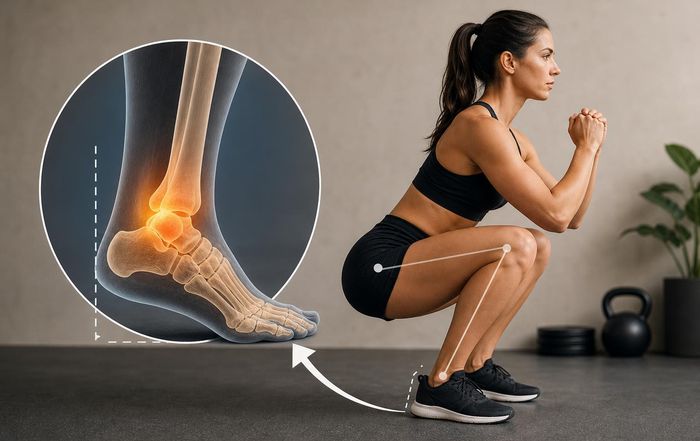
During a squat, the shin must angle forward over the foot. This movement-bringing the knee over the toes-is called ankle dorsiflexion. If your ankle cannot dorsiflex enough, your body has to "find" depth elsewhere. Common compensations include rounding the lower back, turning the feet out excessively, letting the knees cave inward, or lifting the heels to stay balanced.
Research from organizations like the American College of Sports Medicine shows that adequate dorsiflexion is associated with better squat mechanics and may reduce injury risk in the knee and hip joints by improving alignment and load distribution. Limited ankle motion, by contrast, is linked with issues such as patellofemoral pain and altered landing mechanics in sports. You can explore more background on joint function and injury mechanisms via resources from ACSM and NATA.
For general fitness training, sports performance, and even daily tasks like sitting down and standing up, building and maintaining ankle mobility supports:
A more upright torso in the squat, which can be especially important in front squats and goblet squats.
Better knee tracking over the toes, reducing unwanted twisting forces.
More efficient force transfer from the ground up, which matters for jumping, sprinting, and change-of-direction sports.
Comfort and control in everyday movements such as stairs, lunges, and getting off the floor.
For more on how squats fit into overall training, see our strength content in the training and physical fitness sections.
How much ankle mobility do you actually need?
There is no single "perfect" number that applies to everyone, but most strength and conditioning references suggest that around 35-40 degrees of dorsiflexion is adequate for deep squatting in most people. In practice, what matters is whether your ankles allow you to reach your desired squat depth with good alignment and without pain.
The World Health Organization notes that joint range of motion varies naturally between individuals, and that mobility should be considered alongside strength, control, and pain levels rather than in isolation. You can find general musculoskeletal health guidance at WHO.
If you are a weightlifter, CrossFit athlete, or play sports that demand deep knee bend-such as basketball, football, or martial arts-you will usually benefit from more dorsiflexion than someone whose training is limited to partial squats or machines. On the other hand, if previous injuries or structural factors limit your ankles, you can still squat productively by adjusting stance, depth, and exercise selection while working to improve the range you do have.
Our training and sports coverage often highlights how individual anatomy and sport demands shape technique choices.
Simple self-tests to check your ankle mobility
Before you start hammering mobility drills, it helps to know where you stand. Two simple tests can be done almost anywhere. If you have existing foot, ankle, or lower-leg injuries, consider checking with a qualified professional-such as a physical therapist or sports physician-before testing or changing your routine. Directories from organizations like the American Physical Therapy Association and Chartered Society of Physiotherapy can help you locate specialists.
1. Knee-to-wall dorsiflexion test
Stand facing a wall in a lunge position with your front foot flat and your big toe a few centimeters from the wall. Keeping your heel down, drive your front knee forward toward the wall. Move your foot back in small increments until you find the farthest distance where you can still touch your knee to the wall without the heel lifting or the arch collapsing.
Many clinicians use about 10 cm (roughly 4 inches) from toe to wall as a practical benchmark. If you struggle to reach the wall even at a short distance, or if there's a big difference between sides, your ankle mobility is likely limited.
2. Bodyweight squat assessment
With feet roughly shoulder-width apart and toes slightly turned out, perform a slow bodyweight squat:
Keep your heels down.
Let your knees travel comfortably over your toes.
Keep your chest facing generally forward, not straight down.
If you cannot reach at least thigh-parallel without your heels lifting, knees caving in, or your torso collapsing forward, your ankles may be part of the problem. However, hip mobility, core strength, and technique also play roles, so think of this as one piece of the puzzle rather than a definitive diagnosis.
If you want a broader picture of your movement, you can compare your results with functional movement screens and assessments commonly discussed by groups like the National Strength and Conditioning Association and ACE.
What actually limits ankle mobility?
Understanding what is restricting your ankle helps you choose the right strategy. Not all stiffness responds to the same drills.
1. Soft-tissue tightness in the calves
The most common culprit is tightness in the gastrocnemius and soleus muscles and the Achilles tendon. Long hours in heeled shoes, lots of running or jumping without adequate recovery, and simply not training full range of motion can all contribute. This type of restriction often feels like a stretch in the calf or Achilles when you try to drive your knee over your toes.
2. Joint restrictions and previous injuries
Past ankle sprains, fractures, or immobilization in a cast can limit the way the talus bone glides within the ankle joint. This sometimes feels like a block or pinch in the front of the ankle rather than a muscular stretch. In these cases, joint-focused mobilizations and, in some situations, professional manual therapy may be more helpful than endless stretching.
Guidance from bodies such as the American Academy of Orthopaedic Surgeons and NHS emphasizes the importance of proper rehab after ankle injuries to restore both mobility and stability.
3. Structural and individual factors
Some people have naturally less dorsiflexion due to bone shape, previous surgery, or congenital differences. Foot structure (such as very high or very low arches) and tibia length can also influence how the squat looks and feels. If your limitation is largely structural, you can still improve comfort and control, but there may be a realistic ceiling to how much range you can gain. In that case, technique modifications and exercise selection become especially important.
For broader joint health and injury-prevention context, our health and wellness sections often examine how mobility, strength, and lifestyle interact.
Foundational warm-up for ankle-friendly squats
Before loading heavy squats, it makes sense to prepare the ankle joint and surrounding tissues. A brief, targeted warm-up can improve comfort and movement quality without turning into a full training session.
A practical sequence might include:
General warm-up: 3-5 minutes of light cardio such as brisk walking, cycling, or skipping to increase blood flow.
Dynamic ankle movements: 10-15 ankle circles each direction per side and 10-15 gentle heel-toe rocks to move through plantarflexion and dorsiflexion.
Bodyweight squats with a pause: 2-3 sets of 5-8 slow repetitions, pausing for a couple of seconds at the bottom while keeping the heels down and knees tracking over the toes.
These simple steps help your nervous system "rehearse" the squat pattern and may reduce the feeling of stiffness when you begin loaded sets. For more warm-up ideas, explore the fitness and lifestyle sections, which often highlight practical routines for busy schedules.
Targeted mobility drills to increase ankle dorsiflexion
The most effective ankle mobility work usually combines soft-tissue techniques with active movement and load. The following drills are widely used by strength coaches and rehab professionals. If any movement causes sharp pain, stop and seek guidance from a qualified clinician.
1. Calf stretching with a bent and straight knee
Because the gastrocnemius crosses both the knee and ankle, while the soleus sits deeper and only crosses the ankle, it helps to stretch both positions.
Straight-knee wall stretch: Stand facing a wall, one leg back with the knee straight and heel down. Lean forward until you feel a stretch in the upper calf of the back leg. Hold 20-30 seconds, repeat 2-3 times per side.
Bent-knee wall stretch: Move the back foot slightly closer and bend the back knee while keeping the heel down. You should feel the stretch lower toward the Achilles and deep calf. Hold 20-30 seconds, repeat 2-3 times.
The American Orthopaedic Foot & Ankle Society provides general guidance on calf stretching and Achilles tendon health at AOFAS.
2. Half-kneeling ankle mobilizations
This drill targets dorsiflexion in a squat-like position and can be progressed gradually.
Start in a half-kneeling lunge with the front foot flat.
Keeping the heel down and the arch supported, gently drive the front knee forward over the middle toes until you feel a stretch at the back of the ankle or calf, not pain in the front of the joint.
Move in and out of the stretch for 10-15 controlled reps, then hold the last rep for 15-20 seconds.
You can place a light weight (like a small plate or dumbbell) on the front knee to add gentle load as you improve.
This is essentially a controlled, active version of the knee-to-wall test and closely mimics the angles you see in a squat.
3. Loaded dorsiflexion in a deep squat support
Using a stable support such as a squat rack or doorframe, hold on and sit into as deep a squat as you can with your heels down.
From this position, gently shift your weight toward one side, driving that knee forward while keeping the heel planted.
Rock side to side for 10-15 reps per side, focusing on slow, controlled movement.
Keep your chest lifted as much as is comfortable and avoid collapsing the arches.
This drill loads the ankles in a position very similar to your working squat and can be an effective bridge between mobility work and training sets.
4. Ankle joint mobilization with a band (for experienced lifters)
If you have access to a thick looped resistance band and some experience with mobility work, you can use a band to apply a gentle pull at the ankle joint while you move into dorsiflexion. This is often seen in strength and conditioning settings and can be helpful when joint stiffness is a primary issue. However, it is not essential for most people and should be avoided if you have recent ankle injuries or significant pain. When in doubt, consult a professional-directories from ISAKOS and similar organizations can help you locate sports medicine specialists.
Strengthening the ankle for stability and control
Mobility without strength and control is not particularly useful. Once you gain new range, you want to "own" it with active muscle work so it becomes available during real squats and sport movements.
1. Eccentric calf raises
Eccentric (lowering-focused) training has strong evidence behind it for tendon health and flexibility. It is widely used in Achilles tendinopathy protocols referenced by groups like the Mayo Clinic.
Stand on a step with the balls of both feet and heels hanging off.
Rise up on both feet, then shift weight to one leg and slowly lower your heel below step level over 3-4 seconds.
Use both feet to rise back up and repeat.
Aim for 2-3 sets of 8-12 slow reps per leg, several times per week.
2. Tibialis anterior strengthening
The muscle along the front of the shin (tibialis anterior) helps pull the foot up into dorsiflexion. Strengthening it can improve active range and control.
Sit with your legs extended and a light resistance band looped around the top of your foot, secured to a stable anchor.
Pull your toes toward your shin against the band, pause briefly, then return slowly.
Perform 2-3 sets of 12-15 reps per side.
3. Single-leg balance and stability work
Simple single-leg exercises help your ankle learn to stabilize through its available range:
Single-leg stands on the floor, progressing to a folded towel or balance pad.
Single-leg Romanian deadlifts with light weight.
Step-downs from a low box, focusing on smooth control and knee tracking.
These movements integrate ankle control with hip and core stability, which is exactly what you need in loaded squats. You'll find more stability and injury-prevention ideas in our wellness and fitness sections.
Technique tweaks that protect your ankles while you improve mobility
You do not have to wait for "perfect" ankle mobility to squat safely. Thoughtful adjustments can help you train productively right away while your mobility work gradually takes effect.
1. Use heel elevation strategically
Placing small plates or a wedge under your heels, or using weightlifting shoes with an elevated heel, effectively reduces the dorsiflexion demand at the ankle while still allowing a deep squat. This is standard practice in Olympic weightlifting and many strength sports. However, heel elevation should complement, not completely replace, mobility work-especially if your goal is long-term joint health and versatile movement.
If you compete in sports or activities that demand deep knee bend, you may ultimately want a combination of improved mobility and appropriate footwear. Organizations like USA Weightlifting and World Athletics often discuss how equipment and technique interact in performance and safety; their homepages at USA Weightlifting and World Athletics offer broader context on these topics.
2. Adjust stance width and toe angle
A slightly wider stance and modest toe-out can reduce the required dorsiflexion at the ankle while still allowing good depth. However, turning the feet out excessively to "cheat" around stiff ankles can create new problems at the knees and hips. Aim for a stance that lets your knees comfortably track in line with your toes throughout the movement.
3. Choose more forgiving squat variations
While you are working on ankle mobility, some squat variations may feel better and allow safer loading:
Box squats with a controlled, partial range.
Goblet squats, which often encourage a more upright torso and can feel more stable.
Split squats and reverse lunges, where you can adjust stride length to match your current ankle range.
As your mobility improves, you can gradually progress to deeper and more demanding variations such as front squats and overhead squats. Our training page regularly explores how to select and progress squat variations for different goals.
How often to train ankle mobility-and what progress looks like
Like any adaptation, ankle mobility improves with consistent, moderate practice rather than occasional, intense efforts. For most generally healthy adults:
Frequency: 3-6 short sessions per week, often attached to your lower-body training days or as a brief stand-alone routine.
Duration: 10-15 minutes focusing on a mix of stretching, active mobilizations, and strengthening.
Progress markers: Easier depth in bodyweight squats, less heel lift, improved comfort in lunges, and better scores on the knee-to-wall test over time.
Some people notice changes in a few weeks; others, especially those with long-standing stiffness or past injuries, may require several months. It is normal for gains to be gradual and sometimes non-linear. If you experience persistent pain, swelling, or a sense of joint "blocking" that does not change with basic work, consider seeking assessment from a sports medicine or rehab professional. Organizations like FIMS and IOC provide broad resources on sports medicine and athlete care.
Integrating ankle care into your broader health and training
Ankle mobility is just one piece of lower-body function. Sleep, nutrition, overall training load, and footwear choices all influence how your joints feel and perform. For example:
Adequate protein and micronutrient intake support tissue repair and adaptation; you can explore related topics in our nutrition coverage.
Gradual progression in training volume and intensity helps avoid overload to the calves and Achilles.
Rotating footwear and limiting time in very high heels can reduce chronic shortening of the calf complex.
Cross-training with activities that naturally use full ankle range-such as controlled deep squats, lunges, and some forms of yoga-can help maintain the mobility you build.
Health authorities such as the U.S. Department of Health & Human Services and Public Health England emphasize that regular, varied physical activity is central to musculoskeletal health. Ankle mobility work fits neatly into this broader picture as a small, targeted investment with benefits that extend beyond the squat rack.
Putting it all together
Safer, stronger squats depend on much more than leg strength. Adequate ankle dorsiflexion allows your knees to track over your toes, your torso to stay more upright, and your joints to share load efficiently. If your ankles are stiff, you can:
Assess your current range with simple tests like the knee-to-wall drill and bodyweight squat.
Address likely restrictions with calf stretching, half-kneeling mobilizations, and deep squat rocking.
Build stability and control through eccentric calf work, tibialis strengthening, and single-leg balance.
Modify technique with heel elevation, stance adjustments, and appropriate squat variations while you improve mobility.
With a few focused minutes most days and thoughtful exercise choices, many people can significantly improve both how their squats feel and how they perform. Over time, better ankle mobility not only supports safer lifting but also enhances the way you move in sport and everyday life.